Breaking The Chains: a game post-mortem
Back in March, I played out a game of Breaking the Chains simulating an invasion of Taiwan by the People’s Republic of China being countered by a coalition led by the United States. My interest was to get an appreciation of the political-military balance between the potential opponents in the context of this worst case scenario. I had made some adjustments and house rules to include important factors that the original game missed:
- Adding PRC Ballistic Missile attacks on Installations, Troops
- Modeling Airfield Degradation/Repair
- Added US B-2 bombers to the FICC order-of-battle
- Included a more involved political model conditioning alignments of regional actors on game events
I wrote an appreciation of the situation and selected courses of action for both the PRC and the US-lead First Island Chain Coalition (FICC).
The bad news was that the FICC lost decisively in the first four days with Taiwan being overrun by PRC troops. The good news is that many of the deficiencies in the FICC military capabilities leading to the loss are being addressed. I cover a few of these, and most humbly float my own observations based on what I saw.
A Caveat
It has been stated by many others, and I too will say this more than once that wargames are not crystal balls. A wargame result, no matter how one-sided is never a prediction. Each game is a non-repeatable exploration using a set of assumptions in a specific context. Properly executed, a wargame can provide to insights and pertinent questions to be answered through analysis and real-world exercises.
I’d like to follow up with a play of Next War: Taiwan, which has a more precise treatment of the air and ground struggle on the island itself to understand just how the central battle of this campaign could play out and the factor involved. The operational, theatre-level treatment offered by Breaking the Chains gave good context for follow-up questions to answer with other games and analyses.
PRC Course of Action
The PRC Course of Action was designed to establish PRC dominance of the Taiwan strait and the airspace over Taiwan as soon as possible in order to ensure the safe transport of the PRC amphibious forces to the island as soon as practical. The time pressure on the PRC was to take advantage of the FICC window of vulnerability where the FICC was awaiting additional carriers to augment the one Carrier Battle Group on Station.
The PRC began with a massive ballistic and cruise missile attack on airfields on Taiwan and Okinawa to ground the ROC and US Air Forces that would contest for the airspace over the island of Taiwan. Taiwanese airfields were mostly hit using short range ballistic missiles (DF-11 & 15), while the US airfield on Okinawa was hit with medium range ballistic missiles (DF-21C). Defending SAMs were hit using cruise missiles.
What was the FICC trying to do?
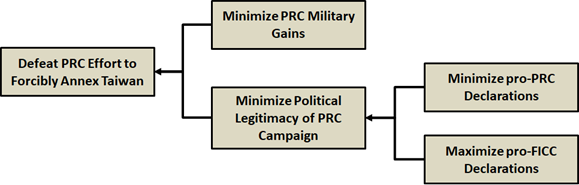
In my estimation, I had posited that the FICC primary objective was to Defeat the PRC Effort to Forcibly Annex Taiwan. This objective was further decomposed into military and political branches of supporting objectives. The political branch was addressed in the game by an enhanced political model which conditioned the probability of potential regional allies joining the respective coalitions to events on the board. The game played did not last long enough (4 days) for much to have happened on the political front, so I will not have much to say on that in this post.

The Operational Plan I used for the FICC had a set of Functions (yellow rectangles above) to realize the FICC Objectives identified (grey boxes). To analyze the FICC failure to achieve their military objectives, I address the shortcomings of the FICC which impacted its ability to carry out the top set of functions realizing the military objective Minimize PRC Military Gains.
The FICC operational plan was broken into two phases; Attrit Amphibious Capacity and Attrit Ground Forces. Each of these phases correspond to the PRC operational centers of gravity being the Amphibious Transports and Landed Ground Forces respectively. As the PRC achieved decisive victory on day 4, this analysis will focus on phase 1 Attrit Amphibious Capacity only.

The FICC plan in phase 1 was to destroy as many of the PRC amphibious transports as possible. By doing so, the PRC would be permanently deprived of the ability to convey troops to Taiwan and achieve their objective of overrunning the island. PRC airborne forces alone were assessed as insufficient to take the island by themselves. The PRC amphibious transports were to be destroyed by a combination of FICC Air (primarily ROC Air Force and US air from Okinawa and US CVBG) as well as US SSNs patrolling the Taiwan strait.
The US CVBG was to patrol to the eastt of Taiwan in an area beyond the range of PRC reconnaissance. A key constraint was that the US carrier could not be allowed to be targeted by the PRC for DF-21 anti-ship ballistic missile (ASBM) strikes. While this area was outside reconnaissance range from PRC land-based air, the USN would have to also take measures to protect this area from PLAN carriers, and from the PLA(N) SSN patrolling the area. If the PLA(N) could get a fix on the US carrier, they could damage or destroy it with unacceptable military and political consequences for the FICC.
The ROC Air Force was mostly out of the fight due to PRC ballistic missile strikes. The PRC started by attacking runways and did enough damage that the ROC air force was largely grounded. The PRC also grounded US air forces in Okinawa using MRBMs. As a result, the PLAAF was largely unopposed in the air over Taiwan, and were able to make precision air-to-ground attacks on the ROC Navy (most of their navy was sunk from the air), SAMs and the grounded ROC Air Force. While the distance from the Chinese mainland to Okinawa meant a lower PRC sortie rate, the PRC was also able to greatly reduce US airpower in Okinawa using the same tactic.
With the ROC and US air forces on Okinawa mostly grounded and slowly destroyed in their hardened shelters by precision air-to-ground and cruise missile strikes, FICC air over Taiwan depended on the CVBG. The CVBG in its safe area was too far from Taiwan to be much more than an “air force in being”; able to threaten PRC amphibious assaults but not contest for air superiority.
Unfortunately, the PLA(N) was able to dislodge the US CVBG from its safe area. The PLA(N) had detailed two of its three CVBGs to force the Luzon strait in order to bring the Chinese carriers within reconnaissance range of the US carrier. Unfortunately for the FICC, the PLA(N) superiority in surface forces (Sovremenny DDGs outnumbering and outranging the US Burke DDGs) won the battle for the Luzon strait for the PLA(N). As a result, the US CVBG had to retreat to the east, leaving the PRC in complete control of Taiwan airspace.
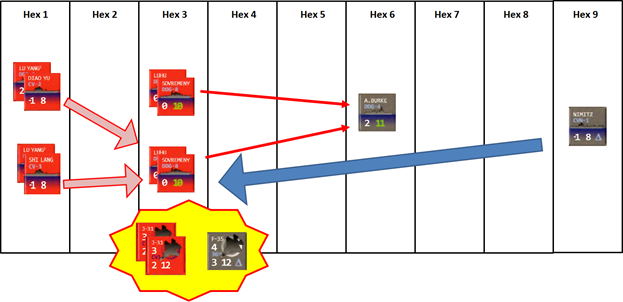
With Air Superiority over Taiwan secured and most of the Taiwanese navy either sunk or huddling out of the way under the cover of the remaining SAMs, the PRC then had their amphibious convoy set sail for Taiwan attended by a sizable ASW presence. The only remaining US remaining to bear were the US SSNs waiting in ambush in the Taiwan Strait. While the US Boats managed to sink a few transports, enough were able to get through to the island and establish a beachhead that the ROC Army could not dislodge.
Attrit PRC Ground Forces
With ROC Air Force and US air driven from Taiwan airspace, the only FICC force which could carry out the PRC ground force attrition function was the Taiwanese army. Unfortunately, the Taiwanese army was significantly degraded by this point due to unremitting PRC SRBM strikes and precision air-to-ground strikes by an unfettered PLA Air Force. The model of SRBM strikes I used may have been too generous to the PRC, but I think it is a fair assessment that hundreds of SRBMs loaded with cluster munitions would have a significant impact on defending troops.
Degrade PRC Air Capacity
With a significant PRC amphibious presence on the island, the FICC needed to degrade PRC air capacity over the island in order to keep the balance from tipping too steeply against the ROC Army in the land battle. Due to the processes described above, the FICC was not able to mount significant Combat Air Patrols (CAPs) by the Taiwanese Air Force or Air Superiority Sweeps by the US air units. To degrade PRC air over Taiwan, the FICC needed to depend on cruise missiles to attack key PRC airfields hosting the PLAAF units pounding Taiwan. While some degradation was achieved by the US LACM strikes (launched from in-theatre US DDGs, SSNs), the effects were not enough to significantly degrade the ability of the PLAAF to launch sorties against the island. B-2 strikes were attempted, with few results (not enough B-2s available to make much of a dent).
How could the FICC have Done Better?
I had not expected the FICC effort to crumble so soon, but looking at the designer notes, he had mentioned that players could expect Taiwan to fall quickly if the PRC player chose to make conquering that island their focus. Given that Taiwan has maintained its independence this long, I suspect that a successful, quick cross-strait invasion is not that forgone a conclusion. I plan on playing an even more detailed game that focuses on the battle in and over Taiwan (Next War: Taiwan) to explore this further. Breaking the Chains was a good start for a theatre-level military-political simulation which will provide context for the more focused simulation offered by Next War: Taiwan.
So, before I give my “make better” assessments, a few more caveats. I acknowledge “garbage in, garbage out”; that my assesments can only as good as my inputs (see the references list below). All sources are unclassified. The game I used is primarily designed for playability by civilians. And finally, I am sure there are perfectly valid military/political/economic considerations that I am not fully aware of that help to explain why the FICC forces are structured as they are. My assessments should in no way be considered “advice”, but it will be interesting to see where folks in responsible positions make changes congruent with what I put here (imagine me with a “Bingo Card” marking where measures I suggest were taken).
All that being said, my fixes come in 2 categories; (relatively) Easy Fixes and Hard Fixes. The “make betters” I put forward are limited to enhance the FICC functions of Reduce PRC Amphibious Capacity, Attrit PRC Ground Forces and Degrade PRC Air Capacity
(Relatively) Easy Fixes
Additional US Carrier on Station at Start of Hostilities
The PLA(N) achieved a “mission kill” of the US carrier by forcing the Luzon Strait and compelling the CVBG to withdraw further to the east in order to avoid detection by the Chinese carriers and possible ensuing destruction by ASBMs. The PLA(N) succeeded in this primarily due to having 2 CVBGs vs the one of the US. Despite US qualitative air superiority, the US could not succeed against the combined PLA(N) naval aviation. The superior PLA(N) surface forces pushed the US Burke DDG pickets back on the CVBG, compelling the US Force to withdraw. Two US Carriers on station at the onset of hostilities would have made all the difference, winning the battle of the Luzon strait and keeping US air in the fight over Taiwan. The possibility of US air available for anti-shipping operations over the Taiwan strait could have been enough to keep the PRC amphibious convoy from sailing for the island.
Fortunately, the US is beginning to up patrols of carriers in the Indo-Pacific recently with three in the pacific for the first time in years. Such a move should positively impact stability and reassure regional allies of US resolve.
Hold PRC Airbases at Risk
The US operational plan required a substantial degradation in PRC ability to put sorties over Taiwan. If the PRC gained air superiority, they would be able to clear the Taiwan strait of the ROC navy, finish the ROC air force grounded by SRBM strikes and to drive the ROC Army away from the planned beachheads. Even with the US and ROC regional land-based air grounded, degraded PRC airfields would have slowed these processes and possibly bought enough time for US reinforcements to stabilize the situation. Since FICC air was unable to do this for the reasons already given, US LACMs launched from DDGs and SSNs in the area had to take up the slack. Unfortunately, there were not enough of these to have much effect. An encouraging development is the refitting of 4 Ohio-Class SSBNs to Tomahawk LACMs. Each of these would be able to launch salvoes of up to 144 cruise missiles from their vertical launch tubes. With these on station, the US could have trickled out enough cruise missiles to hit the most important PRC airfields and relieve pressure on the Taiwanese defenders until more substantial aid could arrive.
The B-2s I added to the game were welcome, but there were too few of them to make a difference. B-2s would be employed most sparingly to hit the highest value targets.
Hard Fixes
Restructuring ROC Air and Naval Forces
In my opinion, judging from the order of battle of the ROC forces in the game and literature – Taiwan may have the wrong force makeup to resist a cross-strait invasion. First, the PRC has SRBMs… lots of them… hundreds verging on thousands pointing at the island. While accuracy may vary, you do not need to be very accurate to punch holes in runways and scatter cluster munitions. SRBMs will shut down the ROC airbases, and then the Taiwanese Air Force will be grounded. Grounded, they are out of the fight and will be destroyed while the PLAAF has free run of the skies. Contesting for air superiority may be beyond the ROC Air Force due to the numerical imbalance, but the good news is that you do not need air superiority to strike critical blows – you just need to be able to fly. This is especially true in Taiwan’s case, as the Chinese Center-of-Gravity in the early phase of this scenario is slow, vulnerable amphibious transports. To fly and do what matters, I suggest the ROC employ air forces employ aircraft using Vertical Take Off and Landing (VTOL) from dispersed, impromptu sites around the island. Much like the original CONOPS of the AV-8 Harrier for operating in the Central European theatre against the Warsaw Pact, ROC VTOL aircraft (such as the VTOL variant of the F-35) would be able to carry out missions in support of ground forces and remain available for the all-important interdiction strikes against the PRC amphibious convoy. While VTOL mean much lighter loads in weapons and fuel (hence shorter range), you don’t have to have too much lift capacity to carry a couple of Air-to-Surface missiles and a couple of Air-to-Air missiles for self-defense. As for range, the aircraft would not need much as they would be operating in hit-and-run attacks over the island and the adjacent strait.
The ROC navy seems like it is structured to be a sea-control force on the cheap. Unfortunately, given the assumption of PRC air superiority given the reasons above, the too few destroyers and frigates of the ROC navy just offer a set of targets for the PLAAF. In my game, the ROC navy barely got into action. Sea control, even locally, may be beyond Taiwan vis-à-vis China. What Taiwan may consider is an enhanced sea-denial navy; denying China a means to cross the strait long enough for help to arrive. Scrap the Destroyers and Frigates in favor of networked swarms of small, Fast stealthy surface forces equipped with anti-ship missiles and diesel submarines. Sure this navy will not help Taiwan maintain their claims on rocks in the South China Sea, but the idea that Taiwan would risk providing the PRC with a cause to use force over such claims in far-fetched.
Lastly, the ROC army should be ready to use maximum mobility as a means to avoid being targeted and hit by PRC SRBMs. The best way to beat a missile is to not be where it is going, and by staying on the move (employing roads off the beaten path and making an additional network of dirt roads), eschewing permanent fixed fighting positions in favor of impromptu fighting positions, and employing tactics emphasizing hit-and-run and ambush attacks the ROC could mitigate the missile threat and remain viable long enough for the tide to turn in the air when US follow-on forces arrive in theatre.
References:
Eric Heginbotham “The U.S.-China Military Scorecard”, Rand Corporation 2015.
IISS “The Military Balance – the Annual Assessment of Global Military Capabilities and Defense Economics 2020”, Routledge 2020.
Alfred Price “Air Battle Central Europe”, Free Press 1986.
Winning at Ultimatum: an example of using Non-Linear Programming for Optimal Targeting
Thinking about a Taiwan Contingency via Breaking the Chains
While wargames are commonly used as a vehicles for “participatory history” in examining battles of the past, Wargames are an unparalleled aid for studying current and future national security issues. Armed with John Gorkowski’s excellent game Breaking the Chains and selected books, I learned a fair amount about how a Taiwan contingency might play out, and what aspects of the respective coalitions would help and harm their causes.
A military campaign against China is one of the more likely and consequential contingencies our defense establishment faces. Much as the US Navy and Marine Corps determined requirements and refined their methods against a hypothetical Japanese threat prior to WWII, the US Defense Establishment will use such a contingency as a focus for determining resources and capabilities and necessary for to deter, and if necessary prevail in such a conflict.
As part of this exercise, I wrote an abbreviated campaign appreciation from the point of view of the U.S. and her likely regional allies. I also made some house rule changes to add important aspects (e.g. PRC Ballistic Missiles) that the game did not include. I’ll do a follow on post-game post to talk about how the game went and some lessons learned.
General Rule Modifications (rule modified):
Diesel Submarine Mobility (14.2) – Diesel subs in illumination range of enemy units must roll 1D10 in see if they can move. On a 6 or greater, they may move or place/remove the Out of Element (OoE) marker as applicable that General Quarters (GQ) phase.
Single Player Modifications: Player rolls 1D10 each Movement or Engagement opportunity; on an even roll the First Island Chain Coalition (FICC: Taiwan the U.S. and its allies who join) gets to move/engage and on odd rolls the CC does. Each movement is done by a single stack per move. Engagements are declared for one hex per roll.
Airfield Degradation: In addition to attacking air units on airfields, Air and Missile strikes may attack the airfield itself. Hit results against the airfield result in Damage levels 1, 2 or Out-of-Action (OoA). Air units operating from Air Fields (either Strike or CAP) suffer an adverse Circumstantial Modifier corresponding to the level of damage of the field. Units may not Strike or CAP out of an Airfield suffering an OoA result, and units operating out of an OaA airfield do not project an illumination radius. Airfield damage is repaired one level each recovery phase.
Ground Unit Losses (15.2): Shock results from strikes and ground combat are applied in order of size from the smallest unit in a stack to the largest unit. Units may not get a second shock result until every other unit in the stack has a shock result.
1.0 Establishment of the Basis for Solution of the Problem
1.1 Appropriate Effect Desired
The US-Lead First Island Chain Coalition (FICC) will preserve the independence of the Republic of China (ROC) against PRC aggression by eliminating PRC ability to transport troops to the island of Taiwan and degrading whatever PRC ground forces that do deploy to impotence vis-a-vis ROC forces. The FICC will also mobilize regional powers against PRC aggression by upholding their rights in contested areas.
1.1.1 Fundamental Objectives Hierarchy
The Effect Desired is realized by the objective Defeat PRC Effort to Forcibly Annex Taiwan. That objective is further decomposed into a primarily military (Minimize PRC Military Gains) and political (Minimize Political Legitimacy of PRC Campaign) components.
1.2 Relative Fighting Strength
1.2.1 General Factors
1.2.1.1 Political Factors
Rules Modifications to Victory Conditions (17.3) and Politics Model 12.0
Either the PRC or FICC may win by a political settlement (Political victory) during the Politics segment of each turn. Both the PRC and FICC start with 0 Political points. Political points may be acquired by capturing selected hexes. The PRC gains 2 political points each of the 6 hexes of Taiwan. The PRC may also get a single point for Okinawa or Guam. The PRC may also capture the Hanoi, the Senkaku hex, or Spratley hex Q16 for a single point each, but in doing so they bring the hex owner into the FICC immediately.
The FICC may gain political points by capturing China mainland hexes Zhan Jian or Ding Hai, or Paracel island hex N11 for a single Political Point each.
Both Sides may also gain political points by Countries declaring membership in a coalition or neutrality per that nation’s political event rolls (described below).
During the Politics Phase, both the PRC and FICC sum up their political points. The side with the most points then subtracts the political points of the other side and rolls 1D10. If the die roll is less than or equal to the difference, then the rolling player wins a minor victory via political settlement.
The PRC wins a Decisive victory as soon as they control all hexes of Taiwan, or upon successful roll for the China Oscar Event.
The China Oscar event is modified so that when the PRC plays this chit, the PRC rolls 1D6 – if the roll is less or equal to the number of Taiwan hexes controlled by the PRC then Taiwan surrenders and the PRC wins decisively. This event may only be played once.
If neither side achieves a Political victory, or China does not achieve a Decisive victory by overrunning Taiwan, then the winner is determined by victory points at the end of 30 turns (1 month). The FICC wins if there is a tie.
The region is home to a number of Countries which may help or hinder the FICC depending on events as the situation unfolds. These countries may participate by contributing military forces to a coalition, or more passively by backing peace efforts of one or the other coalition of active antagonists.
FICC and FICC-Leaning Countries
The U.S. and ROC are the core members of the FICC as they are automatically in the FICC at initiation of hostilities. Japan, Australia and Vietnam may become active participants in the FICC if certain conditions are met.
Japan
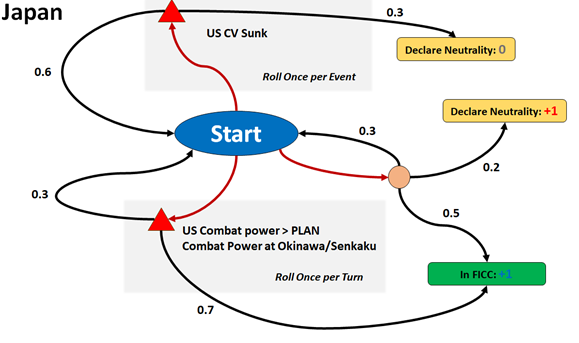
While Japan has a mutual defense treaty with the U.S., it is unlikely that Japan will interpret a Taiwan-invasion contingency (even if there are PRC strikes on American bases in Okinawa or elsewhere) as obligating them to commit their own forces. It is likely that a direct PRC attack on Japanese forces, Installations (Kagoshima), or a move to occupy the Senkakus by the PRC would bring Japan into the FICC.
Japan has a small, but well-equipped Self-Defense Force (SDF) which would act to deny the Senkakus to the PRC and help secure Okinawa. For political reasons, they would not be allowed to engage in Amphibious operations against mainland China.
To increase the odds of Japan entering the FICC, the U.S. needs to reassure Japan by staging combat power in the waters around Okinawa/Senkakus.
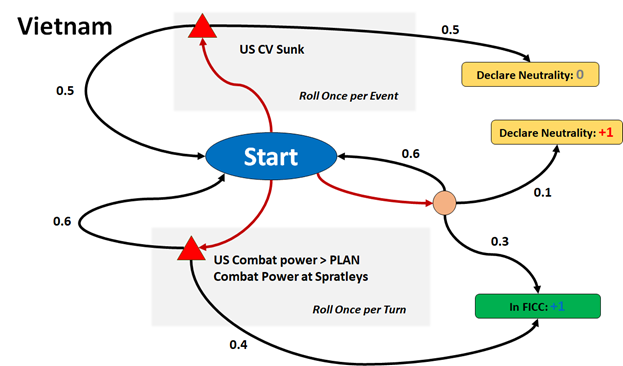
The sinking of a US Aircraft carrier shows up in the political calculations of each country having the make the decision of how or if to become involved. While the loss of a single aircraft carrier would not decisively degrade U.S. combat power, US carriers have an almost talismanic import to national decisionmakers – and a loss a carrier would certainly trigger a re-evaluation of the FICC chances for prevailing in the conflict.
Australia
Australia can be expected to follow its treaty commitment with the U.S. in a Taiwan contingency and contribute forces. While small, the Australian contingent would include an infantry regiment which could be used to support Vietnamese claims to the Spratleys.
Vietnam
Vietnam’s chief aim will be to uphold its Spratley claims without unduly antagonizing the PRC; especially if China seems to be getting the better of the FICC in the conflict. A show of force by the FICC to uphold Vietnamese claims in the Spratleys may be enough to induce Vietnam to join the FICC. Vietnam could contribute forces (which would secure the Spratleys) and provide a vote for a FICC-favorable settlement.
Thailand
While Thailand is not likely to offer military assistance, they do carry weight in regional affairs and can lodge a vote for either the FICC or PRC depending on circumstances.
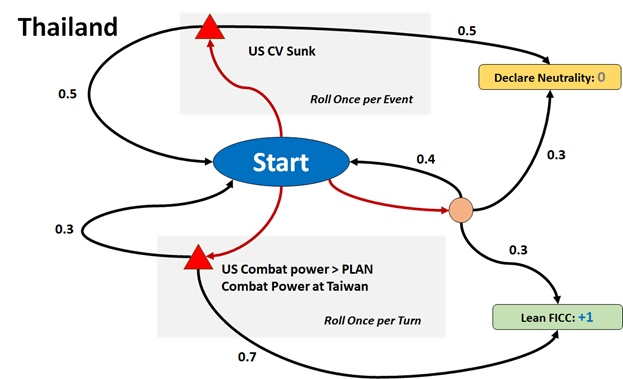
PRC Leaning Countries
Countries leaning towards the PRC are unlikely to contribute their (mostly negligible) military forces to the PRC, but are likely to lend their voices towards a PRC-favorable settlement. The PRC would be unlikely to antagonize them by occupying disputed territory since prevailing in the conflict would allow the PRC to deal with the rival SCC claimants in the future at leisure without U.S. interference.
Philippines
The Philippines leans PRC, but predominant U.S. combat power in the Spratleys may convince Manila to back an FICC settlement.
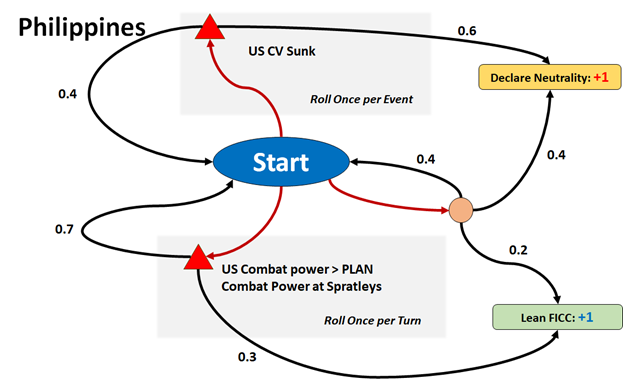
Malaysia, Burma, Cambodia, Laos
These countries are likely to back a PRC-lead peace initiative. In the case of Malaysia, an FICC demonstration in the Spratleys may induce Kuala Lumpur to back a FICC-lead peace initiative.
Burma, Cambodia and Laos would likely look to which power looked to be prevailing in Taiwan. While leaning towards the PRC, these countries value peace and stability and if the FICC seemed to be prevailing, they may back the FICC politically as a vote for the status quo pro ante.
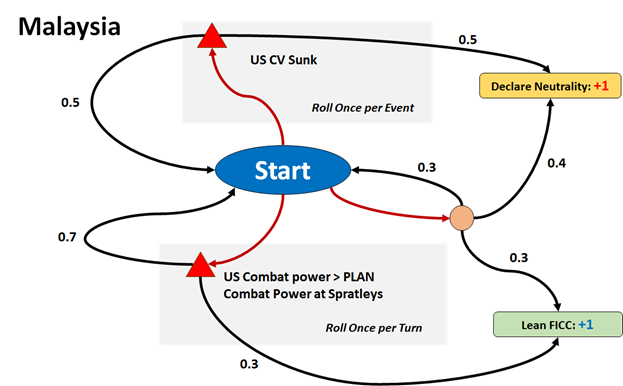
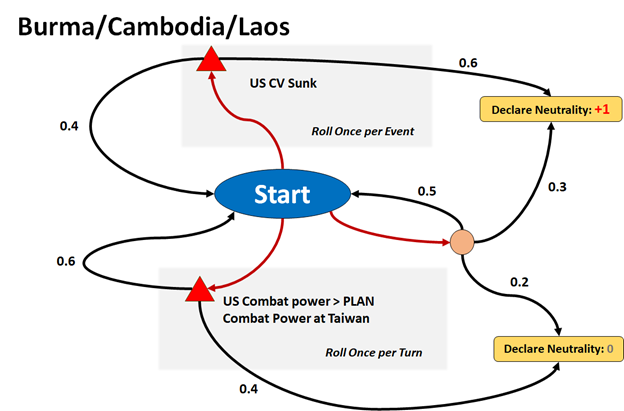
1.2.2 Survey of the Characteristics of the Theatre of Operations
1.2.2.1 Hydrography, Geography, relative Locations and Distances
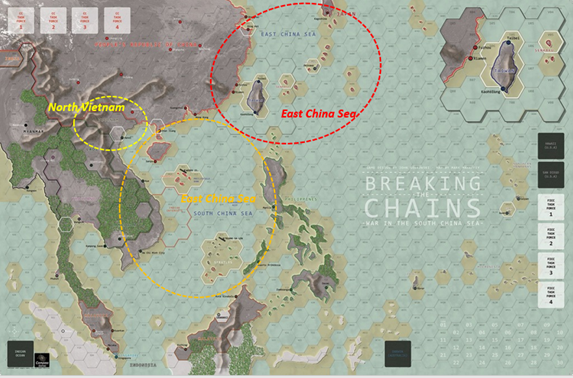
The mapping of Objectives, geographical features and distribution of key installations breaks the theatre into three key regions; East and South China Seas and North Vietnam.
The Key Objectives of preserving the independence of the ROC will be achieved in the East China Sea region. FICC Air forces operating from Okinawa, Taiwan and a US CVBG will first minimize PRCC combat power on the island of Taiwan by attacking PRCC amphibious assault vessels. Subsequently FICC Air and Sea Forces will gradually gain control of the Air and Sea over and around the island in preparation for degrading PRCC forces from the island.
The US will also achieve the supporting objective of securing Japanese active participation in the FICC by a show of force in the waters around the Senkaku Islands.
The FICC will achieve the supporting objective of getting Vietnamese participation in the FICC, as well as the political backing of the Philippines by a show of force in the Spratleys. The FICC will also achieve the supporting objective of drawing PRCC forces from the decisive region with assaults to seize Chinese-held islands in the Paracels.
The US is not expected to directly commit forces to Northern Vietnam, but will support with missiles and/or air strikes in order to support Vietnamese forces as they tie up PRCC forces.
The bulk of US Air and Sea forces are available in theatre at the start, with follow-on forces surging into the area as described below.
1.2.2.2 Key Installations
PRCC
Taiwan Strait
The PRCC will rely on Fuzhou and Xiamen as Airfields to secure air superiority over Taiwan and to project Airpower against ROC ground forces. These sites will also be the staging area for troops embarking for the invasion of Taiwan.
Reconnaissance from Fuzhou and Xiamen airfields will also keep US CVBGs from approaching Taiwan and prevent US amphibious forces from landing on Taiwan.
South China Sea
Woody Island airfield will serve as a tripwire preventing US CVBGs or troops from operating in the Northern Part of the South China sea by acting as the scout for PRCC ASBM forces. Sanya on Hainan island will be vital to defend Woody Island from air strikes or amphibious/airborne assault.
FICC
Taiwan and East China Sea
ROC airfields are vital to attriting PRCC amphibious landings and contesting air superiority over Taiwan. The ROC Airfield of Kaohsiung will be especially important, as it would serve as a scout for the FICC screen of the Luzon Strait.
The US will primarily project Airpower over Taiwan from Okinawa. It is expected that air operations from Okinawa will be significantly impacted by PRCC MRBMs. Okinawa together with Kagoshima will provide scouting and force projection necessary to prevent PRCC forces from heading east out of the East China Sea.
South China Sea
Ho Chi Minh City is the only safe locale that could serve as the origin site for a US Airborne assault on Woody Island in the Paracels.
1.2.3 Factors More Directly Applicable to the Armed Forces
1.2.3.1 Regional Geography
The Island of Taiwan is separated from the mainland by the Taiwan strait. PRC is expected to make an early and vigorous effort to hold and maintain sea control of this Strait, as this is where they would have to cross to make amphibious landings on the easily secured western coast of the island. The east coast of the island also offers the least challenging terrain.
Given the threat of the DF-21D ASBM, US Carriers providing direct support to forces on the island of Taiwan will need to operate in waters to the east of the Island. US Forces must ensure the region remains clear of PRC forces which could scout for the missile forces.
The PRC is able to locally contest sea control in the East China sea enough to enable an amphibious campaign to subdue Taiwan. The PRC can project land-based air, Ballistic and Cruise missile strength in the East China sea enough to suppress ROC defenses and hold CVBGs operating off Taiwan or in the South China sea at risk.
The PRC has limited ability to project power past the first island chain, but by using their carrier battle groups in as scouts for the PRC 2nd Artillery ASBMs, they can achieve a mission kill of US carriers by denying them a safe operating area to the east of Taiwan. To maintain this safe area, the US will need to deny the PRC safe transit of two key waterways.
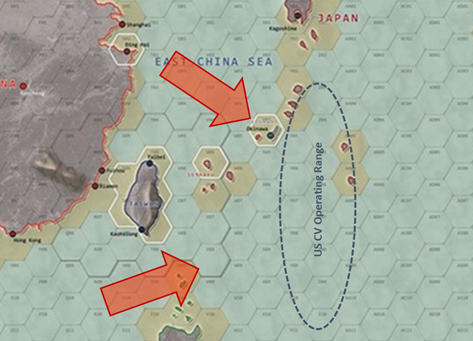
While the East China Sea provides the most direct path to the US CV Operating area, it is barred by the US Base at Okinawa and abuts the Japanese base of Kagoshima. PRC forces transiting these waters would be subject to scouting from these bases, and with this scouting US CVs would be able to sorties without reply from PRC CVs. PRC is not likely to be able to neutralize both of these bases for any significant time, so the risk PRC sorties from the East China sea is considered low.
On the other hand, the Luzon strait between Taiwan and the Philippines (which is expected to remain neutral) provides a path for PRC forces over which they would only need to neutralize one base (Kaohsiung). Given the imperative for the PRC to dislodge US carriers from the waters near Taiwan, and the relative ease to secure this strait, it is judged a near certainty the PRC will attempt to sortie via this waterway.
1.2.2.1 Vessels, including Aircraft and Missiles
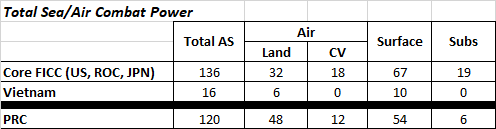
Overall, the FICC (Including U.S., Taiwan, Japan and Vietnam) has more combat power overall in terms of Anti-Shipping firepower in the theatre. This metric is considered most important in the contest of controlling the Sea and Air around Taiwan which is the main FICC Objective.
PRC Ballistic and Land Attack Cruise Missiles
PRC Ballistic missiles (exemplified by the DF-11 SRBM) provide a substantial threat to forces on Taiwan. An estimated 800 or so DF-11 stand ready to attack fixed installations such as Airfields and Fortification and can also be expected to be employed against ROC troops. BTC does not model this, so I used the following model:
RULE ADDITIONS: Chinese Ballistic Missiles
During the GQ phase, the PRC may launch SRBM strikes against either Taiwan or Northern Vietnam (no further south than Hanoi). The PRC player has 100 SRBM points at the beginning of the game, which they may use. To use SRBMs, the PRC player denotes the number of points to use against each target hex (max of 6 points per hex) during each GQ Phase. The number allocated per strike serves as the weapon system score for that strike. SRBM strikes may only be executed against Divisions, Regiments, MEU or Airfields. After each strike, the points allocated to the strike are lost.
SRBM launchers are not modeled in the game as they are considered too numerous to effectively target.
The PRC also employs the DF-21D which can also target Aircraft Carriers underway at sea. The DF-21D has only recently been rated as an Anti-Ship Ballistic Missile (ASBM), so the following rule models the uncertainty of its performance:
RULE MODIFICATION: DF-21D ASBM Performance (16.0)
The Weapons System Score of the DF-21D is modeled as having a 30% Chance at being under-performing (4), 50% Chance of working as predicted (5) and a 20% Chance of being better than predicted (6). The PRC has up to 15 DF-21D shots which they may make during any General Quarters segment. The PRC may only make one DF-21D shot per general quarters cycle.
The PRC also operates a variant of the DF-21 (C), which can hit bases in the Ryukus (Okinawa) or Kyushu (Kagoshima). The PRC gets 10 DF-21C shots in the game. DF-21C shots originate from SSM units.
The Satellite Warfare event reduces all missile strikes Weapon System score by 2 as it does for LACM strikes.
Unlike LACM strikes, ballistic missile strikes may only be launched against Ground Units, Airfields or Ships in Ports – not SAMs.
RULE MODIFICATION: PRC Air Launched LACM
The PRC may make up to 8 LACM strikes using LACMs carried by their H-6 bombers. These LACMs work like any other PRC LACM.
Ballistic Missiles are key to seizing Taiwan, as they are unstoppable combat power which will attrit ROC ground forces, and degrade air fields before PRC boots even reach the island. The scenario will start with an overwhelming bombardment of ROC key airfields and troops. PRC IRBMs can be expected to hit Okinawa at the onset of hostilities as well.
The threat of the PRC DF-21D ASBM constrains operations of US CVBGs in important ways. Given the DF-21D, and the risks it poses to carriers, carriers must at all times operate in manner that keeps carriers out of illumination by any PRC platform. LPH-borne Amphibious forces are similarly constrained – as a result, no amphibious assaults in scouting range of PRC assets is allowed. This makes FICC amphibious assaults on Taiwan, the Paracels or the Chinese mainland impossible.
The PRC is also well-stocked with cruise missiles which can be launched from a number of platforms. Cruise Missiles will chiefly be employed to degrade air defenses at the onset of the conflict, paving the way for follow-on Ballistic Missile and Air Attacks.
The most critical engagement of the campaign will be the ongoing air battle over the island of Taiwan. The PRC will need air superiority in order to further attrit ROC Troops and protect their own fragile beachhead. The FICC will not have the resources to contest for air superiority, but may be able to achieve the FICC objective of degrading PRC ground forces, nonetheless.
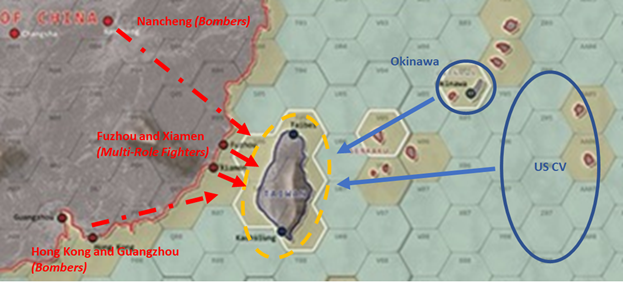
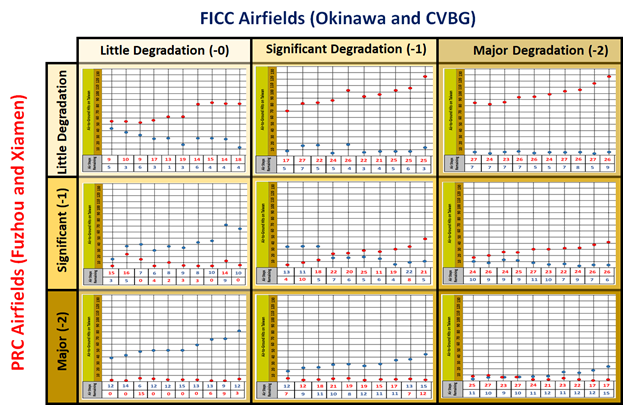
ROC aircraft will be largely out of action due to PRC missile strikes degrading their airfields and subsequent aircraft strikes on grounded aircraft. The PRC heavily outnumbers available (9 units to 5) FICC aircraft. In addition to numbers, the primary PRC airfields (Fuzhou and Xiamen) are close enough to the airspace that they do not suffer degradation of combat performance due to range, whereas the FICC flying from Okinawa and a US CV to the east of Taiwan does. Air superiority is out of the question for the FICC, but if the FICC is able to degrade the primary PRC airbases, they can regain a measure of control over the airspace and most importantly, possibly eliminate PRC ground forces that do manage to get ashore. A simulation of this air campaign was done, using the assumptions:
- PRC starts with 9 multi-role units, FICC starts with 5
- FICC aircraft have air-to-air and air-to-surface performance degraded for long distance
- FICC aircraft fly air-to-ground missions, while PRC fly a matching number of units for each turn to intercept FICC ground strikes, while the remainder fly their own ground strikes.
The key MOE is the number of ground hits the antagonists can deliver in the course of the campaign.
The simulation was run ten times for each combination of airfield states. Each simulation was run for 7 turns of 6 General Quarters phases each. The key takeaway is that the FICC must strive to protect Okinawa and a US CV while degrading PRC airfields in order to contest for ROC airspace.
The game omitted explicitly representing US Strategic air, which I think is a mistake. Penetration of PRC air defenses would be the ideal job for the B-2 stealth bomber, which I added to the game as a single-step unit.
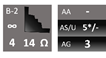
The B-2 is subject to anti-air from Area SAM units as other aircraft, however the SAM needs to get the same number with three dice (versus 2 for other air) in order to hit. The B-2 has no air-to-air capability.
Also the B-2 may only attach Satellite-Illuminated targets in AS combat (as LACM). The B-2 is can be employed via the ‘Widowmaker’ special event any number of times per game, as long as they are not used on contiguous turns. Once eliminated, the B-2s are out of the game.
Unfortunately, being a Strategic Weapons system, B-2 strikes could conceivably be mistaken by the PRC as strikes on PRC Strategic (Nuclear) capacity. Given the relative imbalance of Strategic forces in favor of the US, the PRC would be understandably anxious as to the safety of their own nuclear deterrent. To model this, each time the B-2 strikes a target in a non-coastal hex the US player rolls 1D20. On a ‘20’ the PRC launches a nuclear strike and the US player loses decisively. While the US would not “lose” a nuclear exchange, and further escalation would likely be contained, the idea that the US loses Anchorage Alaska (PRC weapon launch on Elmendorf AFB) due to a misunderstanding in a conflict where US survival is not at stake would give US Leaders pause in employing the B-2 in this campaign.
The PRC will attempt a mission kill on the US CV directly supporting Taiwan by attempting to close on the CVBG with CVBGs of their own. The US CVBGs need to keep a distance of more than 6 hexes from the PRC air units, or they become liable to strikes from the DF-21D. As mentioned previously, this PRC thrust is likely to come via the Luzon strait.
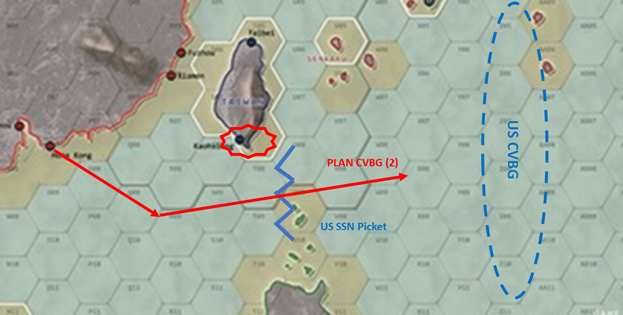
The PLAN will likely send 2 CVBGs, each consisting of a CV, a Lu Yang DDG for area air defense, a Sovremeny and Lu Hu DDG and a Jiang Kai FFG for ASW. All of this arrayed against a US CVN with a set of Burke DDGs performing all roles.
The US CV has a key advantage in the range of their air wing vis-à-vis the PLAN (4 vs 3). They seek to illuminate the PLAN CVs at 7 to 8 hexes distant in order to attack and destroy the PLAN CVs. The first opportunity to do illuminate the PLAN CVs would be from the ROC airbase of Kaohsiung on the south coast of Taiwan. It is expected that this base would have been put out of action by the PRC prior to attempting this operation. The other opportunity comes from the Virginia SSN detailed to picket the Luzon strait. This force has a high likelihood of being able to successfully approach a PLAN CV and enable a US strike. This is the desired outcome for the FICC.
The PLAN will deploy FFGs to find and destroy the US SSN at earliest opportunity. If the PLAN succeeds in getting past the US SSN, then they face the scenario below. Each PLAN CVBG can also be expected to deploy a SAG centered on a Sovremeny DDG attempting to get early illumination of the US CVN with their 3 hex illumination range. This PLAN DDG will operate within range of PLAN air interception for protection. The US should counter by having their own Burke DDGs on picket duty within the 4 hex intercept range of the US air wing.
The resulting situation has 2 Sovremeny-centered SAG vs the US DDG picket. The Sovremenys outrange the US DDG and can initiate AS combat without reply from the US DDG. The US would be able to engage the PLAN SAGs with the US Air Wing, but the Chinese would be able to engage the US air wing via intercept combat, with an advantage both in both numbers and range. While it is possible for the US to prevail in this situation, success is not likely in this situation, so all efforts must be made to succeed with the SSN picket making contact with the PLAN CVs.
1.2.2.2 Ground Forces
The PRC has 14 units, both Marine and Airborne for invading Taiwan. It is likely 1 unit of airborne will be retained as a reserve for the SCC. These forces face a ROC army of 15 units. The limiting factor for the PRC is that only have the capacity to transport 5 units via amphibious assault, and 1 airborne per GQ phase. The FICC will have opportunities to destroy these transports both in transit (via submarine in Taiwan strait) and via LACM as they return to port for more troops. Attrition from these events means that is it unlikely the full complement of PRC units will be transported to Taiwan. We estimate no more than 8 units of Marines will land on Taiwan, and 3 airborne units.
The number of PRC steps on Taiwan drives the PRC requirements for control of the air: they cannot tolerate any scenario that would result in more than 30 ground hits, as this could eliminate PRC forces on the island.
PRC forces will land on the west coast, since the PLAN will likely control the Taiwan strait and the terrain of these hexes make them easier to attack.
Due to the DF-21D ASBM, US may not make amphibious assaults on land within illumination range of PRC air. This precludes amphibious operations on Taiwan or the Spratleys. Taiwan airfields would likely be unavailable as destinations for US Airlift due to Chinese missiles. As a result, US ground operations are probably limited to defense of Okinawa and Guam, and possible offensive airborne operations against Woody island.
2.0 Determination of Suitable, Feasible and Acceptable Course of Action
2.1 From Fundamental Objectives to Means Objectives
Means objectives were devised to respond to the Fundamental Objectives Minimize PRC Military Gains and Maximize pro-FICC Declarations. While a fundamental objective, there were no suitable means objectives to address Minimize pro-PRC Declarations. This objective is addressed mostly via the operational constraints on US CV actions to keep them safe.
2.2 Analysis of the Assigned Objectives and Phasing
The Center of Gravity (COG) for the PRC begins as the irreplaceable Amphibious Transports required to bring the bulk of PRC ground forces to Taiwan. Once these transports are destroyed, the PRC COG shifts to the PRC Marine and Airborne troops on the Island of Taiwan. This shift in PRC COG delineates the two primary phases of the FICC campaign.
FICC (mostly US) air power directly in contact with Taiwan is the FICC COG. US Land-based and carrier-based air will be the primary method for attriting PRC ground on the island of Taiwan.
The FICC campaign consists primarily of 6 operations:
Reduce PRC Amphibious Capacity: Direct operations against Amphibious transports, in transit and in port. Success in the operation reduces PRC forces conveyed, and prevents subsequent augmentation of these forces.
Attrit PRC Ground Forces: Direct operations against PRC Ground Forces, primarily on the Island of Taiwan. This is also achieved indirectly through destruction of Troop-laden Amphibious transports en route to Taiwan.
Degrade PRC Air Capacity: Operations to degrade PRC capability for projecting power against Taiwan via air. This is done primarily through degrading Fuzhou, Xiamen and other airfields directly supporting the invasion.
Show of Force – Senkaku: Operate US CVs in Senkaku area as soon as possible so that Japan is likely to join the FICC in active operations.
Show of Force – Spratleys: Operate US CVs in Spratley Islands area as soon as possible so that Vietnam aligns with FICC in the interest of upholding its Spratley claims. Similarly, induce Philippines to side with FICC to uphold their claim. Secure Vietnamese and Philippine claims against subsequent PRC aggression.
Seize Woody Island: Get PRC to commit forces to protecting Woody Island from possible FICC airborne assault. This operation succeeds to the degree it keeps PRC forces away from the main action in Taiwan. Seize Woody Island if opportunity arises.
3.0 Courses of Action
3.1 Likely Enemy Course of Action
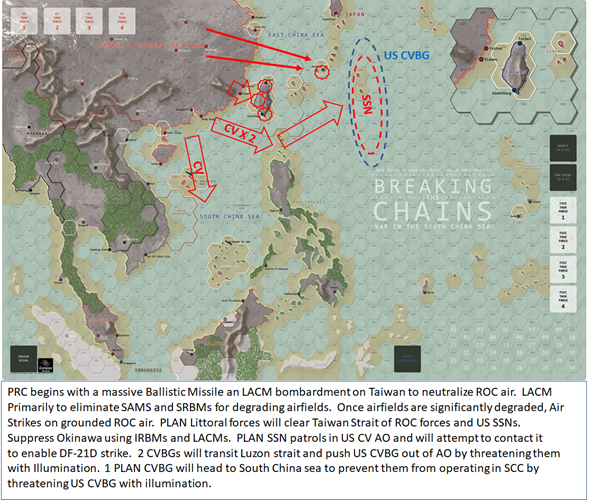
PRC will be on the Strategic offensive in invading Taiwan, but Strategic Defensive in SCC. The PRC will open their campaign with a massive bombardment of SRBMs and LACMs on Airfields and SAMs on Taiwan and IRBMs and LACMs on Okinawa. The Air campaign against Taiwan will proceed in three steps:
- ) Eliminate SAMs via LACM
- ) Degrade Airfields via SRBMs
- ) Eliminate grounded Aircraft via Air-to-Ground Strikes
Simultaneously, the PRC will follow reduce Okinawa through LACM/IRBM attacks. Once sufficiently degraded, PRC Bombers will conduct Air-to-Air strikes to eliminate the grounded Aircraft.
The PRC will remove the US CVBG from it op area through direct attack via an SSN patrol which will attempt to make contact in order to enable a DF-21D ASBM strike on the CV. The PRC will also transit the Luzon strait with 2 CVBGs to confront and drive off the US CV with the threat of illumination and subsequent DF-21D ASBM strikes.
The PLAN littoral units will clear the Taiwan strait of ROC navy units and provide security against US SSNs. Control of the Taiwan strait will be retained, enabling the transfer of PRC units between the East and South China sea along interior lines.
Once the PRC cleared the Taiwan strait and has ensured security from air attack on the Taiwan strait, the PRC will commence with an amphibious assault on a Western coastal hex of Taiwan. PRC Airborne forces will directly augment this assault as available.
PRC amphibious transports will make as many repeat trips to Taiwan as possible. The PLAAF an PLAN air units will then focus on protecting PLAN ground forces on the island of Taiwan through defensive air ops and continuing attacks on Okinawa. It is expected that the US will regain sea control off eastern Taiwan upon the arrival of reinforcements. The PLAN CVs will then operate under security of PRC land-based air, and use their air in defensive operations to protect CV ground.
3.2 FICC Course of Action
The FICC will operate in two main Areas of Operations: East and South China AOs. Operations in both AOs proceed in two phases.
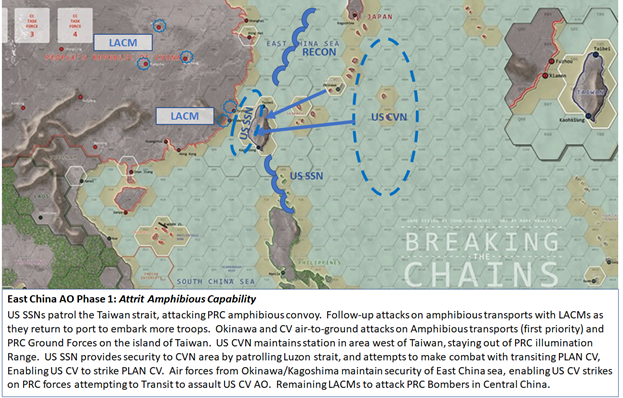
East China AO Phase 1: Attrit Amphibious Capability
Initial FICC strikes will focus on eliminating SAMs at Fuzhou and Xiamen, with secondary strikes on SAMs protecting bomber bases.
US SSN patrol the Taiwan strait to eliminate as many PRC amphibious transports as possible.
US CVBG will provide a show of force off the Senkakus, paving the way for active participation by Japan in the FICC.
US Land (Okinawa) and CV Air Units will conduct air-to-ground strikes on PRC Amphibious Transports (first priority) and PRC troops on the Island of Taiwan. The US CVNs off Taiwan will operate at a distance from PRC air units to prevent their illumination (6 hexes) and consequent destruction by ASBMs. This CV AO will protected by security measures on the Luzon strait and East China sea, preventing PRC forces from sortieing against the CV AO from either of those areas.
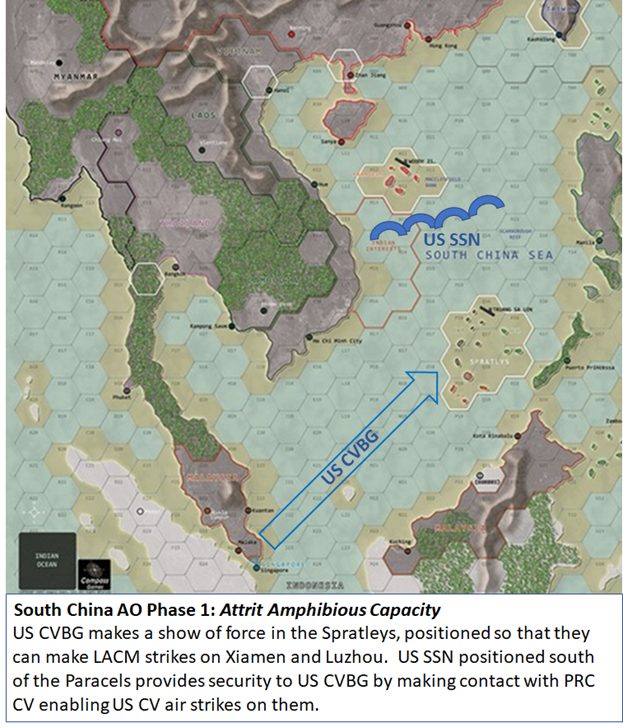
South China AO Phase 1: Attrit Amphibious Capability
The US CVBG will make a show off force off the Spratleys, and position itself to enable LACM strikes on PRC airbases at Xiamen and Luzhou. Security for this force will be provided by US SSN positioned south of the Paracels.
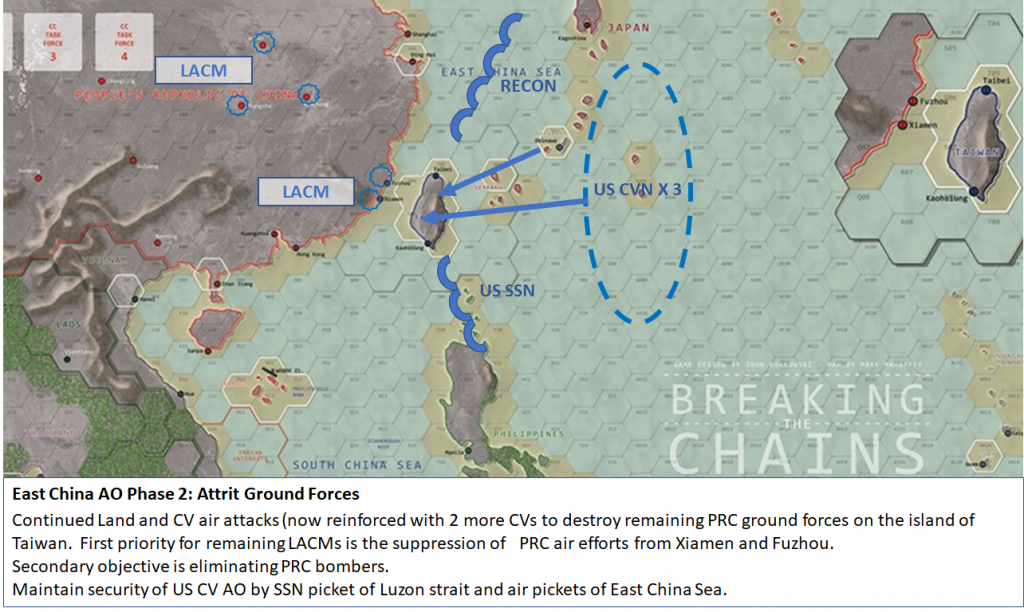
East China AO Phase 2: Attrit Ground Forces
FICC Air strikes (now augmented up to 3 CVBGs) focus on eliminating PRC ground forces on the Island of Taiwan. LACM and B-2 strikes on Xiamen and Fuzhou suppress PRC air over Taiwan. Security measures on the East China Sea and Luzon strait protect the US Carriers in their AO.
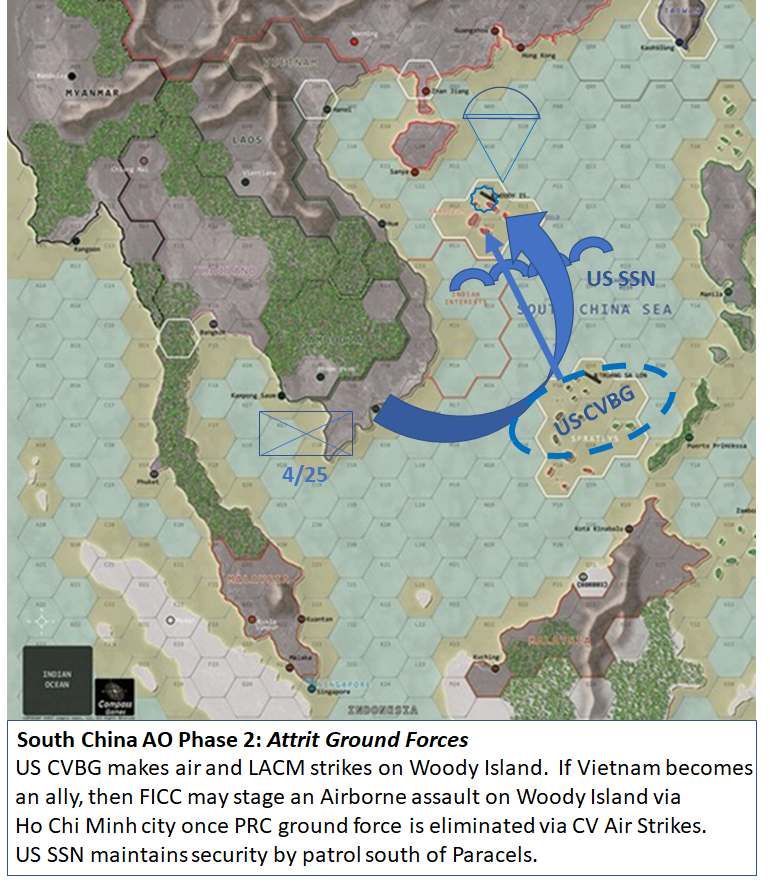
South China AO Phase 2: Attrit Ground Forces
FICC threatens Woody island and ties up PRC ground, sea and air forces in its defense keeping them from defending against the main FICC effort in Taiwan. LACM strikes on Woody Island to eliminate SAM followed up by CV Air Strikes on ground forces open the island up to Airborne Assault. US CVBG continues to perform LACM strikes on main PRC airbases of Xiamen and Luzhou.
Bibliography:
Toshi Yoshihara and James R. Holmes “Red Star Over the Pacific (2nd Edition)” Naval Institute Press 2018.
Eric Heginbotham “The U.S.-China Military Scorecard” Rand Corporation 2015.
The Tactical Appreciation – A “Checklist” for Planning Battles
If you’re a wargamer like myself, you derive a satisfaction from knowing you’ve played your best possible game anytime you’ve set down to play a wargame. You’ve got a job and a family, so you don’t get a “kitchen pass” as often as you’d like to get away and play. The setup of a wargame is a considerable investment in time and prep, let alone the time to play it. So after all the schedule clearing and legwork to get one on the table, it is beyond anti-climactic to have a game go south on you all due to some blunder you could have foreseen with just a little bit of planning.
Good wargames not only present you variety of ways to win (or lose) a game, they also reward players for using the same sorts of thought processes actual commanders use to determine their own courses of action. Good news for us “civilians” that this process for analyzing the objectives and context is pretty straight forward and can improve your own wargaming outcomes – it’s called the Military Appreciation, and I’ll cover an example based on my own solitaire bout with a low-complexity wargame.
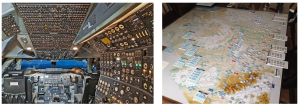
Any player who has sat down at their first monster wargame may have been similarly overwhelmed by the amount of information thrown at you; not unlike sitting at the controls of a 747 for the first time.
The Military Appreciation is a tool for focusing commanders on what matters in order to create, evaluate and select courses of action which are latter refined into executable plans. For wargaming, the course of action is mostly what is needed, as we don’t have the myriad logistical and other details that the staff would elaborate as part of making an actual executable plan.
The Military Appreciation can be thought of as a set of cardinal concerns which any commander must grapple with on the path to making a plan. For this exercise, I used a relatively simple wargame which could be played solo – Michael Kennedy’s We Shall Fight on the Marne published by White Dog Games copyright 2012.

The appreciation I wrote uses the seven major sections of an Attack appreciation as described in the British Junior Staff Course Guide to the Tactical Appreciation. These sections are The Aim, Limitations, Relative Strengths, Ground, Enemy Courses, Own Courses, and Selection of Course. In this scenario, I wrote an appreciation for the Allied (Franco-British) attack at the Marne on the Germans.
These sections should not be done strictly in sequence, but should be done iteratively, starting with The Aim. Since we’re doing this for playing wargames, much of this work is done by looking at the scenario description and victory conditions. As you fill the sections out, they eventually provide enough context for courses (own and enemy) as well as discriminators between the respective own courses you’ll use to evaluate your own options.
Aim
The Aim, simply stated, is the outcome you will achieve through the successful execution of your selected course of action. While the rules and scenario will describe how you get victory points, in the Aim, you get to describe exactly what subset of conditions you’ll bring about to get you enough victory points to win.
The Allied aim is to attack and secure primary objectives (Viller-Cotterets, Chalons and Reims) by the evening of 9 September. While the Allies will seize and attempt to hold the secondary objective (Chateau-Theirry), this will be a supporting effort to aid securement of Reims.
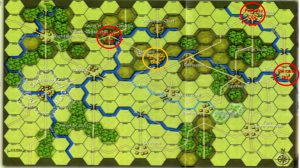
Limitations
Limitations, as you might guess, are the constraints your plans are subject to. You get these chiefly from the rules, the scenario description and based on what you judge necessary for success for your selected course of action.
- The Allies must secure the primary objectives by the evening of 9 September.
- The Allies must ensure enough forces remain to the East of Paris to prevent its investment.
Relative Strengths
Relative Strengths is a comparison of your own situation relative to the enemy summarizing everything that makes your job easier or harder based on your relative situations. This is more than a numerical correlation of forces, but should also consider initial dispositions, command and control, supply, morale and other factors which the rules and scenario description suggests.
Command and Control
The Allies enjoy both an initial (4 Command points to 2) and ongoing advantage in Command and Control. The Allied Cavalry are primarily on the front line and available for Scouting, while the German Cavalry reserve is initially in the rear in the vicinity of Ouchy-le-Chat. This will afford the Allies a crucial early advantage at the onset of the counter attack.
The imbalance in command points will make afford the Allies advantages in mobility (e.g. night movement) and flexibility.
The German 1st Army has the major weakness of having its headquarters well to the rear (north of the Ouroq) of its main strength along the Grand Morin.
Given the Selected Objectives, initial Distribution of Forces and Axes of Attack, the Battle is conceptualized as a complementary set of two battles; East and West. The Relative Strengths will be assessed in terms of these two Battles.
West Battle
In the West Battle, the Allied 6th Army faces the German 1st Army, which is divided into a weak West Flank and strong Southern contingent. The West Flank contingent includes the 1st Army HQ.
The BEF faces the German 1st Army Southern Contingent across the Grand Morin.
The German 2nd Army in included in the West Battle, as we predict it will fall back on Chateau-Theirry to dislodge the French 6th Army.
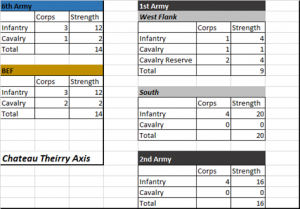
The 6th Army enjoys a margin of strength over the German 1st Army west flank enough to ensure the German contingent can be push aside in the initial drive to Villers-Cotterets. This drive will result in German 1st Army HQ fleeing even further from their Southern contingent, ensuring that that contingent stays out of command for the remainder of the battle.
While the BEF is at a strength disadvantage vis-à-vis the southern contingent, the BEF is strong enough to commit the southern contingent and prevent it from either falling back on Chateau-Theirry, or advancing on Paris.
East Battle
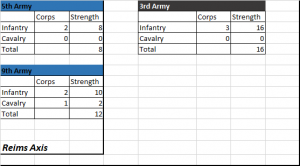
The French 9th army immediately faces the German 3rd army. While the French 9th is at an immediate disadvantage vis-à-vis the German 3rd, the Germans 3rd is deployed in a manner that allows the French 9th to concentrate overwhelming force on German XII Corp. In by attacking and dislodging (pushing it north across the Marne) XII Corp will be split up the middle on a North/South Axis, with 3rd Army HQ forced to move back out of command range of the 2 remaining corps of German 3rd Army. Subsequently, the German 3rd Army will be prevented from massing it’s full strength.
French 5th Army is sufficient for it’s initial task of securing French 9th army’s flank from the German Second Army, and combined with French 9th army will be able to overwhelm the German 3rd Army.
Ground
Ground describes the main features of the area the battle will be fought, in terms of what will help and hinder you in winning.
West Battle
The advance on the primary objective Villers-Coterrets will proceed along the Paris-Meaux-Viller-Cotterets road. Taking this direct path will help ensure the secondary objective Chateau Theirry is taken at the earliest possible time.
The east-west Marne river can provide a defensive barrier to German forces moving against Villers-Cotterets and Chateau Theirry from the South. It can only be crossed by the bridges at Meaux and Chateau Theirry or Pontoon bridges (which the Germans will not have the Command points to make freely). It is important to secure Chateau-Theirry as early as possible.
Primary objective Villers-Cotterets has the Ourcq river before it from the East, providing a fallback defensive line for French forces falling back from the secondary objective Chateau Thierry. Villers-Cotterets also has Hills/ forests to the North/Northeast to aid in defense. This latter feature will be especially important, as we do not expect to be able to secure the bridge at Ouchy-le-Chat.
The Grand Morin is crossed by 3 bridges, 2 of which are under German control. These bridges afford the Germans multiple paths for attaching the BEF. The Allies must take or otherwise neutralize these bridges to reduce German options for crossing the Grand Morin.
East Battle
The Marne is crossed by 3 bridges north from Fere-Champoenoise to Reims; each of these bridges are under German control. The main road to Reims runs through hills and a forest which may be used by the defending Germans to slow down a French advance. Effort must be made to keep the Fere-Champenoise-Reims road as clear as possible
The gap in the hills south of Epernay and south of Sezanne are key to protecting the west flank of French 9th army. This gap is filled by the Saint-Gond Marshes, which further slow down advances by the enemy. This gap must be secured to protect the advance on Reims by French 9th Army
Enemy Courses
Enemy Courses describes the broad plans your enemy may employ to defeat you. There are many schools of thought as to how to go about determining this, but it seems safest to plan from enemy capabilities as opposed to intentions. The aim here is to cover the main option the enemy has available so that you can reasonably expect that you’ll have evaluated your own plans against the major aspects of each of their available courses. Think of the set of enemy courses of action as the “axes” which describe a space in which the actual enemy plan may have aspects of each of these courses.
In an attack appreciation, the enemy courses should actually be considered after own courses of action are laid out – your primary focus should be on what you need to make happen (offensive mindset).
We Shall Fight on the Marne comes with a solitaire engine for the Germans. This engine takes into account the current Allied situation, and returns a German approach for the turn per a die roll.
Allied Situation
A – Allied Forces are south of the Grand Morin River and hold or are adjacent to the Saint-Gond marshes; the French Sixth Army moves toward the Ourcq River.
B – Allied Forces are north of the Grand Morin and nearing the Ourcq River.
C – Allied Forces are at the Marne River and are across the Ourcq River.
| D6 (Down) | A | B | C |
| 1 | a | a | a |
| 2 | b | a | a |
| 3 | c | b | a |
| 4 | c/d | c | a |
| 5 | c/d | c/d | a |
| 6 | e | c/d | a |
German Approaches
a – German units move to defensive terrain (hills, rivers, towns, woods) and hold.
b – German Second Army moves west to attack Paris.
c – German Second (or Third) Army moves north to defend the Ourcq and conduct offensives against any French forces in that area.
d – German Third Army attacks Sezanne.
e – All German units attack south across the Grand Morin River.
While this system provides German approaches on a per-turn basis, there are some non-sensical behaviors possible since the system only selects an approach based on evaluation of the current turn. For instance, the German could end up “yo-yoing” the German 2nd army, alternating between having it advance on Paris, or falling back to the Ourcq to check French 6th army. Accordingly, I modified the solitaire system to stick to a course of action after a set of evaluations. The result is three German Courses of action (slanted, grey parallelograms). These German courses of action can be considered “terminal states” which the Germans will commit to until the end of the game.
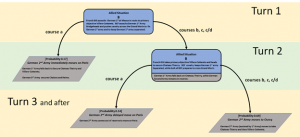
The Germans have 3 primary courses of Action, the difference between the courses being German 2nd Army’s task. In all cases:
- German 3rd has the task of defending Chalons/Reims from French 9th Army
- German 1st Army, its mobility limited by being out of command, falls back to defend the Ourcq and Marne objectives.
German Course 1: Immediate Move on Paris (Probability 0.17)
German 2nd Army crosses the Grand Morin and moves on Paris.
German Course 2: Delayed Move on Paris (Probability 0.14)
German 2nd Army spends the first and second turns in reserve, but commits to a drive on Paris on turn 3.
German Course 3: Defending north of Grand Morin
German 2nd Army moves to contest French 6th army at Chateau Thierry and Villars-Cotterets.
Own Courses
In Own Courses, you lay out possible plans in the same spirit as you did in Enemy Courses; each of the plans laid out possibly achieve success (i.e. realize the aim) in the given context described in the previous sections, but the courses as a set have the elements that will comprise the actual plan. The courses should be distinct enough so that you can be sure the actual best plan is somewhere in the space described by this set.
Three main Allied courses of actions were considered. All of the courses have these main features:
- A Decisive attack by French 6th army on the west flank of German 1st Army to seize primary objective Villers-Cotterets and to seize secondary objective Chateau Theirry. The purpose of seizing secondary objective Chateau Theirry is to drawn German 1st and 2nd armies away from Paris and in the case of German 2nd army, to keep it from interfering with the Decisive attack by French 6th
- The fixing of German 1st and 2nd Army by a combination of maneuver and assault. This will reduce German potential for either disrupting the Decisive effort on Chalons/Reims or advancing on Paris.
- A Decisive attack by French 9th Army on German 3rd Army to take primary objective Chalons and then to press on to primary objective Reims.
All Courses:
French 6th Army Assaults to dislodge to the North the right flank of German 1st army in order to take primary objective Villars-Cotterets. Upon seizing Villars-Cotterets, French 6th will seize secondary objective Chateau Theirry to afford defense in depth to primary objective Villars-Cotterets. French 6th will offer just enough resistance at Chateau Thierry to slow down German offensives towards Villars-Cotterets.
French 9th will assault German 3rd army in order to break through and seize the Fere-Champenoise – Reims road. This breakthrough will be effected in such a manner that the right and left wings of German 3rd army are kept separate, allowing French 9th army to defeat the respective portions of German 3rd Army in detail.
French 5th seizes Sezanne to fix German 2nd Army, preventing it from easily falling back on the Marne, or advancing on Paris.
Allied Course 1: Immediate BEF Crossing of Grand Morin in Force
BEF destroys the Grand Morin bridgeheads, denying German 1st army paths to cross. BEF moves to cross the bridge to 0607 in force, allowing it to get to the rear of German 1st and support French 6th.
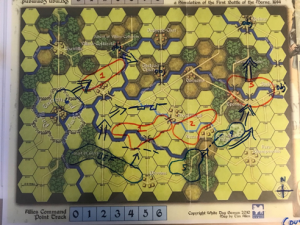
Allied Course 2: BEF Attacks!
BEF assaults the German 1st army south of the Grand Morin and secures the bridgeheads, while BEF cavalry maintains the separation between the south and west portions of German 1st army. The BEF maintains momentum northwards to further divide the south portion of German 1st army, and moves north to the Marne to support French 6th army.
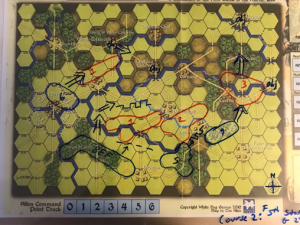
Allied Course 3: BEF in Reserve
BEF assaults the German 1st army south of the Grand Morin and secures the bridgeheads, while BEF cavalry maintains the separation between the south and west portions of German 1st army. However, the BEF remains on the south side of Grand Morin until German 2nd army commits to either moving towards the Marne or Moving on Paris. If German 2nd army moves on Paris, BEF will stop it. If German 2nd moves towards the Marne, BEF will support French 6th army by engaging German 1st from the rear to slow it down and keep it from moving on the Marne from the south.
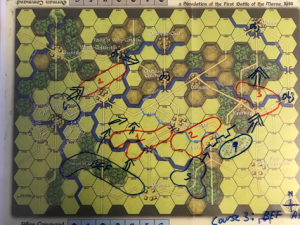
Comparison of Courses
In the Comparison of Courses, you evaluate each of your Courses against each of the Enemy Courses, noting the strengths and weaknesses of the match ups. An NxN matrix is helpful here.
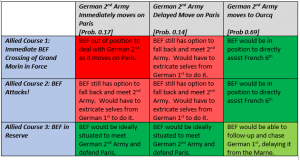
Selection of Course
Hopefully you’ll have a dominant Course which is strong against each of the identified enemy courses; this is the course you should select. The selected course may take elements of the courses not selected, so that the superior hybrid course is what is elaborated into the plan you actually play.
The Allies select Course 3: BEF in Reserve. Course 3 provides protection for Paris against German courses 1 and 2, while providing support to the decisive effort of French 6th army in the case of German course 3.
For Further Reading:
A Guide to the Tactical Appreciation, Land Warfare Centre – Junior Staff Wing. UK MOD 1988
FM 5-0 (FM 101-5) Army Planning and Orders Production, HQ Department of the Army
The US Maritime Strategy of the 80s: an Appreciation Part One : The Game, House Rules and Setup
As covered in a previous post, the US Maritime Strategy marked the high water mark of the responsibilities of the US Navy. For the first time in its history, the US faced a truly global maritime threat that needed to be met with maximal force simultaneously in theatres around the world. Unlike WWII where the US elected to handle Nazi Germany and the Japanese empire in serial, WWIII at sea would have required free world forces to aggressively seize and hold the initiative in multiple theatres simultaneously in order to prevail.
While generally well received by warfighters, and cogent and persuasive enough to legislators to countenance the 15 Carrier Battle Group/600 ship navy required, there were a number of criticisms of the Strategy which could reasonably lead one to question the plan’s viability. In the next few posts, I will blog how I put the Maritime Strategy through its paces using contemporary documentation/intelligence assessments to guide Soviet and Free world play and using the boardgame “Seapower and The State” as the simulation.
Selected Criticisms of the US Maritime Strategy
Tactical Nuclear Readiness
The US Maritime strategy understandably plays to the strengths of the Free World alliance; advantages of relatively free access to the oceans and access to material resources (which unfortunately must be transported over vulnerable SLOCs). While the strengths of the Free world navies were though to be strongest in a longer, conventional struggle (i.e. time to eliminate the soviet navy at sea and to bring full firepower to bear on vulnerable Soviet flanks), the enemy gets a veto – and that veto could have come in the form of tactical nuclear weapons.
As a number of commentators had noted [e.g. Polmar, Van Cleave and others], the US Maritime Strategy seemed to treat tactical nuclear warfare as an undesirable contingency as opposed to a very likely condition that needed to be explicitly countered in the strategy.
As I found while doing the appreciation, the Soviets were well equipped for tactical nuclear warfare at sea, particularly in terms of standoff weapons delivered by aircraft. The US Maritime strategy specifies that Free world forces would deny the soviets access to the oceans by applying forward pressure, but this forward presence would have put forward battlegroups in a situation of grave disadvantage if (indeed, when) the Soviets elected to employ tactical nuclear weapons.
Strategic Escalatory Hazards of an anti-SSBN strategy
Another potential issue with the US Maritime Strategy was the focus on destruction of Soviet SSBNs as a means of forcing the Soviets into decisive battle. The idea was to attack something the Soviets had little choice but to defend, and in the process annihilate their war-making ability at sea. Critics pointed out that such an approach might force the Soviets to “use or lose” their SSBN-launched missiles if faced with the destruction of a significant number of them. This question might need other games to more explicitly treat the issue of strategic (nuclear) stability (i.e. what do I do if my secure second strike is in jeopardy?), but my selected game will at least provide a context for it.
An Appreciation of the Situation via “Seapower and the State”
After reading a bunch of books and briefs, I found a game “Seapower and the State” which covers the situation (WWIII at sea) at the level (Global) necessary to treat the scope of the US Maritime Strategy.
My hats off to Stephen Newburg for his treatment of the subject; nothing but respect for being able to make a game that covers so much territory in a mere 13 pages of rules.
Below are some house rule adjustments I made in order to tweak the game to more adequately cover my questions.
Escalation Model (Level Effects – 5.3)
The game has 5 levels of conflict ranging from peacetime ops (level 1) to conventional combat (level 2), tactical nuclear (level 3), operational (theatre) nuclear (level 4) and strategic nuclear combat (level 5). As you might imagine, the game ends with a strategic nuclear exchange (or turn 10 of combat).
As called out in the 1984 publication of the Maritime Strategy, a major Uncertainty faced by the strategy was the potential for escalation to nuclear combat (tactical, theatre, strategic) [NWPT 33, pg 96]. It was assessed that nuclear war at sea would be a net disadvantage to the Free World forces. In looking at the situation though the game, I agreed with this assessment. While the Free World surface and submarine forces generally match the Soviets in availability of tactical nuclear weapons, the Soviets Air units in the game have tactical nuclear capability while the Free World allies do not.
The 1984 publication of the Maritime Strategy also makes the point that use of nuclear weapons on land would likely drive whether they are used at sea or not. Most geo-political assessments of WWIII revolved (correctly in my opinion) around the “Central Front”; the struggle for the Federal Republic of Germany. In a general conflict (as opposed to a regional war in the Persian Gulf or Korea) with the Soviets, a major aim of the Soviets would be neutralizing NATO by either overrunning West Germany or capturing enough of it to force a costly settlement from the West. Therefore progress (or lack of it), on the Central Front would have been a major escalation driver for the Soviets. The example given in the 1984 Maritime strategy says that if the Soviets seemed to be doing well on land conventionally, they would be less likely to use nuclear weapons on land and much less likely to escalate to their use at sea. This makes sense, since the object of the conflict would be won on land (even more so for the Soviets), and if it seemed that their armies could achieve the main object on land conventionally, it would not do to risk it all by allowing escalation at sea.
As such, I added a land warfare model so that the escalation considerations due to the land war would be more explicit during play. My model abstracts the land campaign as a Markov Matrix showing progress for the Soviets as state transitions from the current state (rows) to subsequent states (columns).
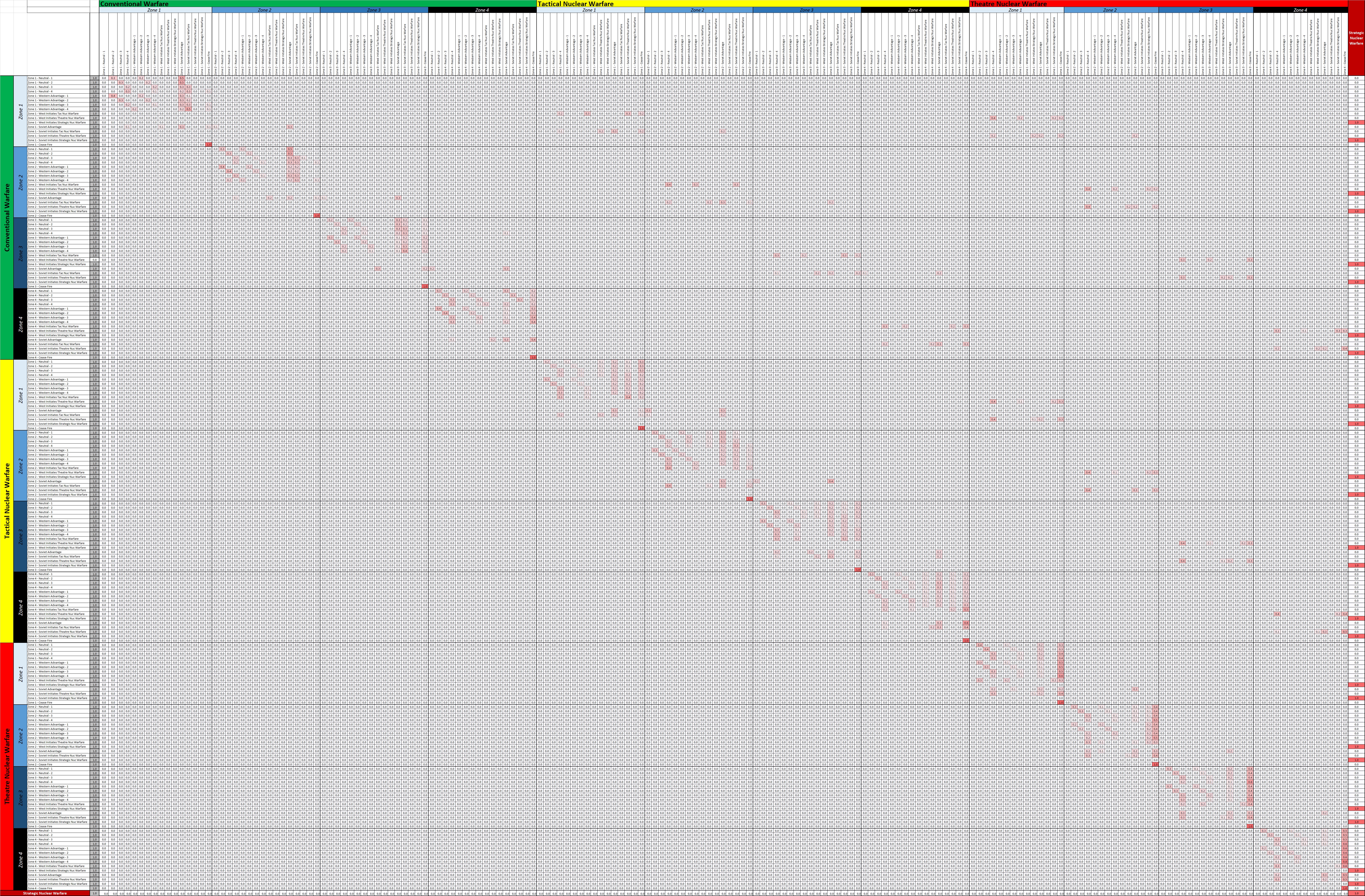
The progress on land was abstracted into 4 zones. In each zone, you can have a state of Western, Soviet or neutral advantage in that zone. There are superstates for Conventional, Tactical and Theatre nuclear warfare where the armies continue to contend. There are also states for cease fires. The general pattern is that if the Soviets do not make enough progress, they begin to entertain escalation to tactical and then theatre nuclear weapons use. The West also has the option of escalation, with the aim of war termination (nuclear combat slows Soviet progress, and makes cease fires more likely in subsequent rounds). As the Soviets make it further, cease fires become more likely than escalation (they figure they have achieved enough of their aims to not have to risk it all with escalation).
A 1D10 is rolled at the beginning of each turn to determine the state for the turn. For the first turn only, instead of the matrix, the players roll 1D10 against the following outcomes to determine the initial state (‘0’ being a 10):
1-3: Zone 1 Conventional Neutral 1
4-9: Zone 1 Soviet Advantage
10: Zone 1 Western Advantage 1
The transition roll for the ground campaign is performed once per turn before the Conflict Level Determination Phase (i.e. do it first in the Turn Sequence).
Escalation is handled as per the original rules, but I’ll discourage nuclear escalation by a player if their side is doing well on land. Also if land had escalated to nuclear use (tactical, operational or strategic), then the players are not penalized with victory point loss for escalating at sea per 17.44.
I added a house rule that escalating to tactical nuclear use cost 40 VPs. This triggers the “West/Soviet Initiated Tactical Nuc Warfare” result on the ground transition matrix.
I added a house rule that on turns where the Soviets managed to interdict any of the major trans-Atlantic SLOCs (i.e. A, B or D) then the Soviet player automatically gets the most advantageous transition matrix result from the current state on the turn after next (warfighting material takes time to get to the front via ship, so the bite is felt 1 game turn after – about 4 days real time).
The game ends upon a either a Cease Fire result (from my matrix) or strategic nuclear exchange (per rule 19.2). Therefore, the sea game does not determine when the game ends by itself.
The assumption made in my scenario (the 1989 scenario) is that the soviets initiate the conflict on very short notice in order to catch the western navies off position. The free world naval positions the first few turns allow the Soviets a window of opportunity to interdict SLOC via air, and to prepare their bastions via mining. Also, it seems to have much of a chance on the central front, the Soviets need all the surprise they can get.
Victory Points (17.0)
Primary Free-World Aims [Breemer, pg. 136]
- The destruction of the Soviet Navy, the US Navy’s only competitor of consequence on the world’s oceans
- Force the Soviet Union to divert military forces that otherwise face the Allies on the Central Front
- Prevent the Soviets from dispatching their attack submarine fleet against the allied SLOCs
- Change the correlation of strategic nuclear forces to the allied advantage, thereby making prolongation of the war increasingly risky for the Soviet Union
Primary Soviet Aims [NWP 11, pg. 119]
- To deploy and provide “combat stability” (that is, protection and support) for ballistic missile submarines in preparation for and conduct of strategic and theatre nuclear strikes.
- To defend the USSR and its allies from enemy sea-based strike forces
- To support ground force operations in the land theatres of military operations, including protecting Pact sea lines of communication and preventing naval support to enemy operations in peripheral areas such as Norway
- To conduct some interdiction of enemy SLOCs
For the most part, the Victory Point schedule reflects the respective aims of the protagonists, but I made the following tweaks.
17.44 Escalation
As mentioned before, if the ground transition matrix escalates to nuclear use then the sea players may escalate up to that level without penalty (e.g. if the Ground transitions to Theatre Nuc use, then players may escalate up to that level with no victory point penalty).
Free World Carrier Strike Posture
To reflect the capability of CVBGs to influence events on land (as the Allies planned and Soviets feared), the Free World player earns 5VPs for each turn for each US or French CV in an Eastern target hex. This also reflects the ability of Free World forces to project power ashore in the form of Amphibious forces (in addition to air strikes) which would draw Soviet forces away from other theatres.
Other House Rules
7.0 Localization
I think there is a problem with the localization rules of Submarines in that it is too easy to find subs. In effect, submarine attacks are almost suicidal in the original rules, which is clearly not in accord with contemporary concepts for submarine operations. For instance, the US Maritime Strategy features submarine operations in well-defended Soviet waters which would be most unwise given the original rules of this game. The sortie of the British SSN HMS Conqueror versus an Argentine task group in the Falklands war (in which the SSN sank the Argentine Cruiser General Belgrano) would have been highly inadvisable in the original rules. Accordingly, I made the following change:
7.2 (Localization) Procedure – Modifications for Submarine Localization
To attack a submarine (phasing or non-phasing – Phasing Submarines are no longer automatically localized) it must be localized. Once a submarine is localized, it remains localized for the remainder of the Combat Sequence of that Turn.
Surface Forces attempting to Localize Submarines
Localization attempts against submarines (non-phasing) is performed each AS combat round the non-phasing sub participates in AS Combat (all submarines may elect to not perform in AS Combat).
Localization may be attempted by Surface Forces during the Submarine Localization phase. Phasing Surface Forces may pool their EW values, while phasing submarines may not. Phasing submarines may attempt localization individually.
Localization is attempted on each submarine individually. Surface forces may add their EW values together in localization (and with air). All forces (surface forces as a group, submarines individually) then attempt localization on each enemy sub individually either as the submarine participates during AS combat or during the Submarine Localization Segment.
Surface Forces attempting localization sum their EW values divide by the EW value of the target sub of the localization attempt (using any applicable EW modifiers ). In cases where the localization target participated in SA combat, round fraction up, otherwise round fraction down) use 1D10 on the table below:
| Surface EW to Sub EW Ratio | Chance of Detection |
| 5 to 1 or above | 80% |
| 4 to 1 | 70% |
| 3 to 1 | 60% |
| 2 to 1 | 50% |
| 1 to 1 | 40% |
| less than 1 | 20% |
Submarines attempting to localize other submarines do this as described in the rules, except that localization attempts may be performed if the target sub engages in SA combat or during submarine localization as described for surface forces above. Submarines must attempt localization individually against individual submarines (i.e. may not pool EW values).
13.0 Mine Operations
I am playing this game solitaire (alas, as most wargames are played), and since mine placement is secret in the original rules, I use the following house rule to make the game more solitaire friendly.
Mines are placed/removed as in the original rules (albeit with a mine marker which I made), but now mine combat is performed on any enemy vessels which move in the hex of the mine marker or any adjacent hex. During the movement phase, the phasing player rolls 2D6 and adds the current mine level as a modifier for each affected hex in the movement. On a 10 or greater, the phasing player must stop in the current hex and suffer the effects of mine combat. On any other roll, the phasing player may continue movement.
14.0 Satellite Operations
Another thing I really like about this game is the explicit treatment of Space operations in the game. Both players must carefully manage Communications, Reconnaissance and Anti-Satellite assets to achieve their aims. However, I think the game is too generous in providing access to space (the original rules have unlimited launches). I made the following change:
At the beginning of the Satellite Operations Segment, the phasing player rolls 1D6 and consults the chart below to determine the number of launches they may attempt this turn:
5 or 6: 2 Launch Attempts this turn
3 or 4: 1 Launch Attempt this turn
1 or 2: 0 No Launch Attempts this turn
The Soviet player may launch any mix of Communications, Reconnaissance and ASATs in a turn, up to the launch number for the turn and as they are available in the inventory.
The Free World player may never launch more than 1 ASAT per turn.
16.12 Aircraft Interdiction (of SLOCs)
The Soviet Player must allocate aircraft for interdiction from designated operative Eastern bases. The player must be able to trace a route from the base to any hex on the interdicted SLOC subject to the aircraft movement restrictions of 6.52.
The Soviet Player may only allocate aircraft for interdiction up to the designated base’s capacity.
16.2 Bases Capture & Inoperative
Disregarding these rules as they seem unrealistic.
16.51 Early Wavering
For turns 1 thru 5, the FW player rolls 1D6 for each nation on this list:
NE, UK, IT, FR and JA – On a roll of ‘1’ that nation negotiates a separate peace and exits the conflict
Western B-52 Strikes
The game short-changes the West in terms of strategic air. While the Soviet player has their Backfires, Badgers, Bears and Blinders fully represented (given that so much of their maritime strength is in aircraft), the Western player has to make due with units mostly representing maritime patrol. In a global conflict, the West would also have use of strategic bombers in conventional roles, namely B-52s flying from forward bases such as Guam, Diego Garcia and the Azores or all the way from Barksdale, Louisiana with aerial refueling if necessary. The capability to reach out and touch Soviet bases via air becomes really important in dealing with Soviet client states off the beaten path, yet in position to interdict vital shipping routes (e.g. Angola, Mozambique, Socotra in the Gulf of Yemen). These out of the way, relatively soft targets are the kinds with could be neutralized in B-52 raids like the Conakry Raid described in General Sir John Hackett’s The Third World War – The Untold Story (pgs. 84-85). In the story the Soviet client state of Guinea host an airfield with the Soviets used as a refueling stop for Soviet bombers interdicting the Atlantic SLOCs. The West elects to take it out with a flight of B-52s out of Barksdale in the first offensive combat mission of the war.
To model this capability, the Western player during the Assign Aircraft segment may roll 1D6 on the following table:
5 or 6: 2 Raids this turn
3 or 4: 1 Raid this turn
1 or 2: 0 No Raids this turn
A B-52 raid may only be done against an Eastern class 3 base in a non-target hex. This restriction models the ability of a Flight or 2 of B-52s being able to but relatively small, lightly defended bases out of commission in a single sortie. More substantial bases would have adequate defenses to make more sustained efforts necessary. A raid, makes the base inop for the remainder of the game.
The Western Player loses the ability to carry out these strikes at Conflict Level 4 (theatre nuclear war).
Pimp my Game
There are a few things that the game needs to be playable, in my opinion.
Markers and Play Aids
This game definitely skimped on markers. Aircraft should have “currency” markers so you can allocate them to battles around the board. Originally, you were supposed to write down what aircraft are going where, but that is an accounting nightmare, especially during battles. I Also added other markers for game turn (front: Soviet, back: Free World), mine markers (per my solitaire rule) and some others.
The most important markers you need are Stack markers (along with stack sheets to hold the unit counters of the stacks). The game involves some horrible stacks, especially around Europe (imagine teetering stacks of a dozen units!). I’ve included stack boards for each side, along with victory point tracks (victory point markers included as well – ones, tens, hundreds and positive/negative).
Other nice marker adds are “AS Fired” markers for aircraft on the battle board and fast transit (7.35) markers to denote submarines which are noisier due to fast speeds.
The battle board steps players through the combat sequence and gives them a place to put the participating units.
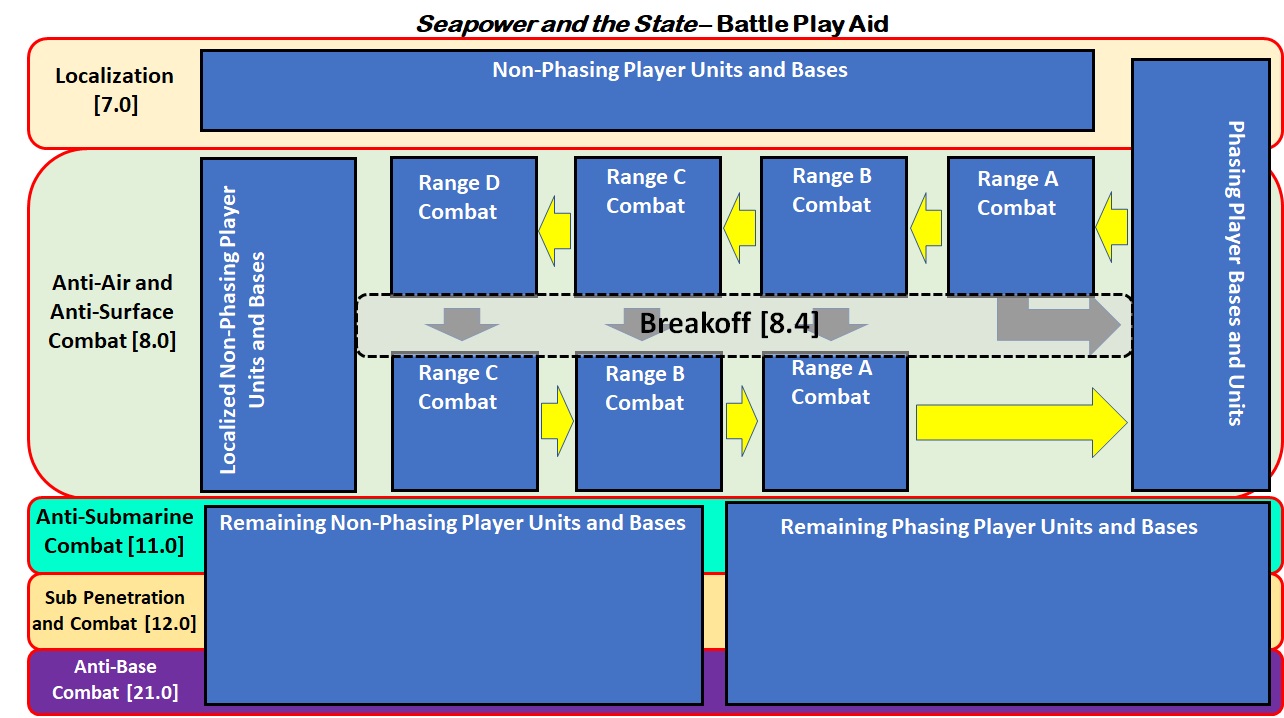
A sign of a great game is that you enjoy just having it set up to look at; bask in the contest to be simulated as a system of related concerns that fits on your table!
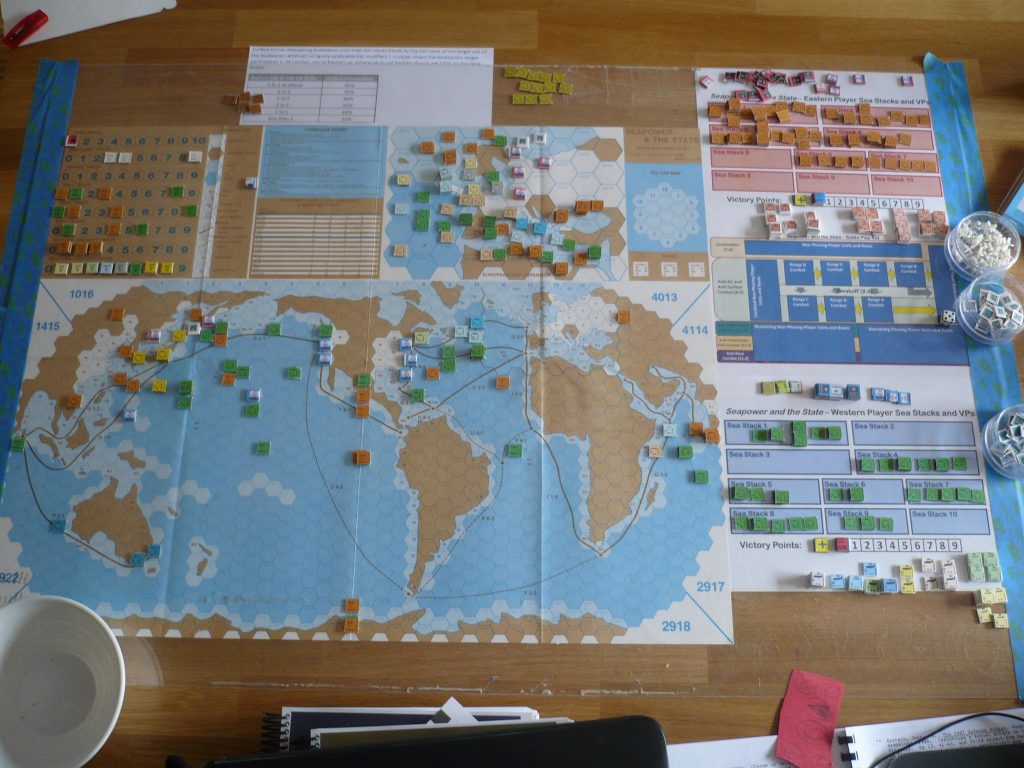
In part 2 of this post, I will go over how I’ll play the respective sides in each theatre based on the Maritime Strategy and contemporary Intelligence estimates of Soviet Capabilities and intentions.
References
[NPT 33] Naval War College Newport Papers 33 – U.S. Naval Strategy in the 1980s (selected documents), John B. Hattendorf, Peter M. Swartz, editors. Naval War College Press, Newport (2008)
[NPT 19] Naval War College Newport Papers 19 – The Evolution of the U.S. Navy’s Maritime Strategy, 1977-1986, John B. Hattendorf, editor. Naval War College Press, Newport (2004)
Newberg, Stephen. “Seapower and The State – A Strategic Study of World War Three at Sea, 1984-1994”. Simulations Canada, 1982
[Breemer] Breemer, Jan. Soviet Submarines – Design, Development and Tactics. Janes Information Group (1989)
Criticisms of the Maritime Strategy can be found in Peter Swartz’s The Maritime Strategy Debates: A guide to the renaissance of U.S. naval strategic thinking in the 1980s (Naval Postgraduate Schoool – 1988). The criticism most salient to my concerns (the potential for nuclear combat and escalatory concerns of the strategy) can be found in the Swartz bibliography (cited here):
Polmar, Norman, “The Soviet Navy: Nuclear War at Sea”, Proceedings, July 1986, pp 111-113. (“The Maritime Strategy must be challenged for its lack of definition in how we are to deter nuclear war at sea”)
A description of the Conakry B-52 raid:
Hackett, Gen. Sir John, The Third World War – The Untold Story, Sidgwick and Jackson, London, 1982
For all the Marbles: The U.S. Maritime Strategy of the 1980s
A big part of what I want to do with this blog is to look at particularly interesting epochs of change in military affairs, particularly in U.S. military affairs with a (critical) eye out for lessons learned. Usually, the historical subject is selected based on which game I want to get on my table lately. In this case, the game was Seapower & the State: A Strategic Study of World War Three at Sea, 1984-1994 by Stephen Newburg published by Simulations Canada in 1982.
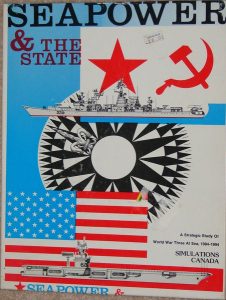
I came across this game when I read The Art of Wargaming by Peter Perla and read his description of how he used this game to introduce analysts to Wargaming as a tool for understanding strategic contexts. Given my soft spot for contemporary, strategic-level simulations (especially WWIII circa 1980), I predictably got onto Boardgamegeek and acquired a copy. When I got it on the table, I was not disappointed in the least. In 12 pages of rules, Stephen Newburg managed to distill many books worth if material on the relative Doctrines and Strategies of the Soviets and NATO/Free World navies of the 1980s. It is a tribute to this game, that it has been a joy thus far just to have the game set up on the table in order to appreciate the overall statement on the subject presented by this game. I decided to use this game as a vehicle to evaluate critiques of the U.S. Maritime Strategy (awkward name… as if there were no other Maritime Strategies…ever!) of the 1980s.
While the study of Strategies is an ongoing theme for this blog, the U.S. naval strategies of 1890-2000s are particularly interesting as they touch on so many of the geopolitical issues of their respective times, reflecting our national aspirations, fears, capabilities and values and expressing them in a form that presidents could advocate, legislatures could fund and servicemembers could fight.
Studying Strategy
Strategy, broadly defined, is the intentional allocation of resources to achieve stated aims. As such, strategies reflect the realities of their times (e.g. threats, goals available means, geo-political context) and can serve as convenient “chapters” for understanding the evolution of a nation’s defense establishment.
Given the scope of naval issues, it seemed to me that naval strategy seemed a good place to start as a vehicle for looking at how the American concept of “hard” (i.e. force and the threat of force) power has evolved over the turbulent 20th century.
Brief Overview of American Naval Strategy 1890-1900
The modern American navy was born in the 1890s. Fears of European encroachment on the new world and newly acquired overseas responsibilities were met with growing American industrial might coupled with the vision of maritime power prophets such as Mahan to create a seaborne force that would matter in international affairs. In that decade, the U.S. navy rejected the traditional sea-denial (commerce raiders with Ironclads/Coastal artillery for harbor defense) concept to become a sea-control force centered on a battle fleet.
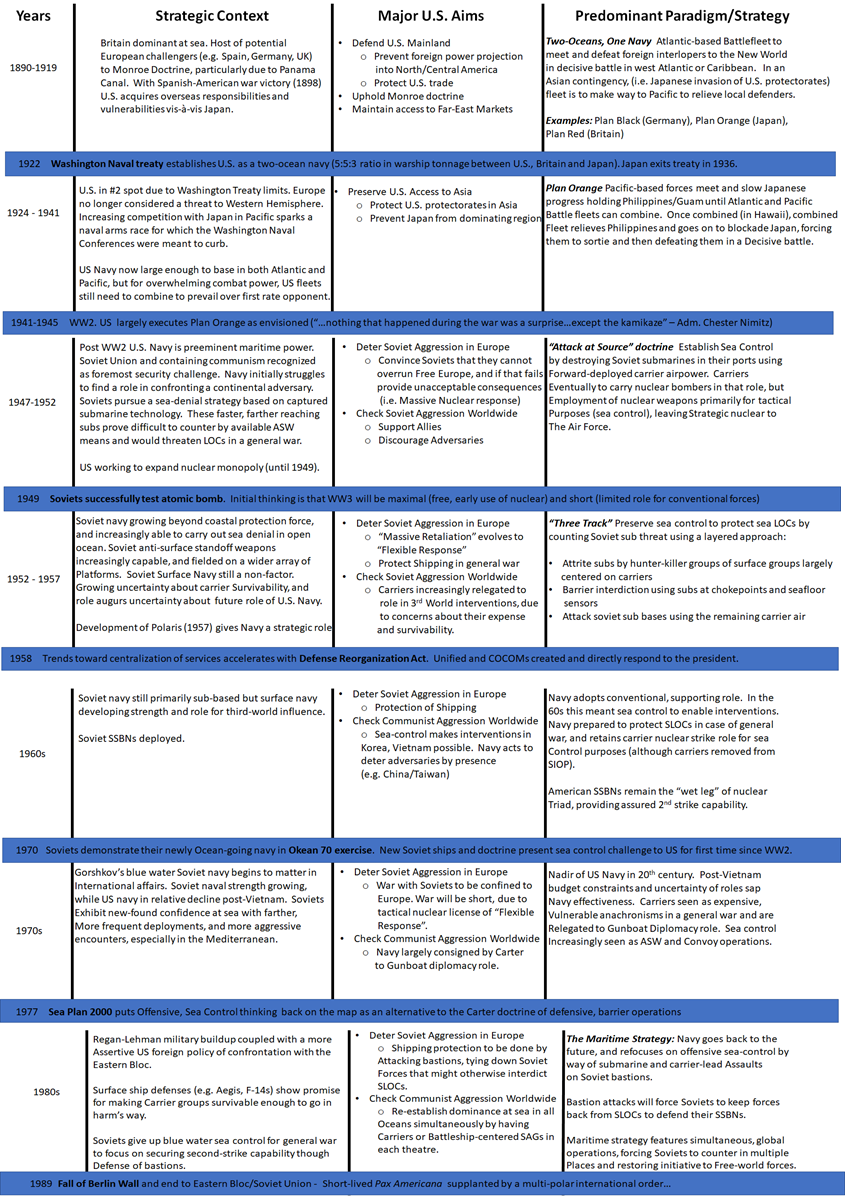
The Maritime Strategy of the 1980s
The Maritime Strategy of the 1980s represented the high water mark of the US Navy in so many ways; resources, political clout, international influence and combat power. The strategy, and the thinking behind and around it generated by both military and civilian members of the defense community was a return to form, marrying the concepts of offensive sea control to the Mahanian concept of decisive battle (in this case not a single battle but a fight the adversary can not refuse). Norman Freidman summed up The Maritime strategy most neatly in “The US Maritime Strategy” here:
The Maritime Strategy, as developed explicitly since 1982, revives a classic equation: that sea control can most effectively be seized and maintained through the early destruction of the enemy navy, i.e., through projecting sea power into his operating and base areas. Moreover, the threat of that projected power (against such valued assets as his strategic submarines) is intended to force the enemy into an early decisive battle. Promptness is important for two reasons. First, it prevents the enemy from dispersing his forces into the open ocean, where they can do enormous damage before they are tracked down and killed. Second, it frees up power projection forces to affect the land battle, which is almost certainly going to be part of the larger conflict in which the naval war is embedded.
A study of the Maritime Strategy seemed to be a good place to start analysis of US naval strategies for two reasons. The first reason is that the idea of seizing the initiative through offensive means of sea control is in the US maritime strategic DNA. While we may occasionally stray towards seaborne Maginot-like constructs such as barrier ASW for cost saving reasons occasionally, the US institutional memory and values favor initiative and positive action as the means to win conflicts. Secondly, there are many issues in the Maritime Strategy that are still relevant today (e.g. how to project power into contested areas ~ A2AD).
My unstated 3rd reason is that I wanted to get a particular game on the table – the aforementioned “Seapower and the State” from the beginning of this post.
I will cover my selected critiques of the Maritime Strategy and appreciation of the situation represented and associated hypotheses I want to tackle using this game in subsequent posts.
For Further Reading:
Freidman, Norman “The US Maritime Strategy“. Naval Institute Press; 1st Ed. (U.S.) edition (1988)
Baer, George W. “The U.S. Navy, 1890-1990 – One Hundred Years of Sea Power“. Stanford University Press (July 1, 1996)
Palmer, Michael A. “Origins of the Maritime Strategy“. Naval Institute Press (1990)
Introducing my homebrew wargame: A Distant Thunder
I am going to go out on a limb and say that just about every wargamer who has been playing games for decades has had an idea for a game of their own that they have at least semi-seriously tried to implement and have published. In my experience, I can think of at least 3 easy ways for a Player to suddenly find themself becoming a Designer:
- Those “house rules” to a loved game that metastasized into a game in its own right
- Tweaking a previous game to cover another subject or scenario
- Coming up with Campaign Rules for an erstwhile battle game (how my game got started)
This being said, if you have the time and intense, almost proselytizing interest in a gaming topic..
You should design a wargame
Really why not… so far nothing too mystical about it, and there are a bunch of upsides to going through the process.
Wargame Design has been a great way of learning/experiencing a topic of interest. Wargame design gives one the opportunity to “live” in the period of the topic and delve into not just the record of what happened, but to understand what could have happened and why. Selecting a topic, posing a set of questions, and scoping enough of the subject to make a worthwhile game requires one to conceive and represent a piece of history as a dynamic system.
If you are looking for a true left-right brain activity, you could hardly do better than Wargame Design. You get to take a historical topic, do a bunch of qualitative and quantitative analyses, and try to represent it in a closed form that fits in a box and can produce credible outcomes in a playable amount of time. Making it work requires probability and statistics, graphic design, historical analyses, storytelling and lots of clear writing.
I have not done a survey, but I suspect that part of the renaissance of wargaming we’ve been experiencing has been the influx of a new generation of game designers that have taken notes on playability and accessibility from the wider world of Euro-games. When I started gaming back in ye olden days (the 80s, when lovable dinosaurs such as Avalon Hill, SPI and Victory Games walked the Earth), counters stalking hex-demarcated maps ways pretty much most of what you would see. It took a critical mass of new design talent to introduce new mechanisms (e.g. cards-driven games, etc.) allowing wargames to more fully tackle aspects of conflict such as politics and economics. Today’s more varied, subtle and powerful wargaming treatments are reaching a wider audience, resulting in a virtuous cycle of more and better games in my opinion.
My “Accidental” Wargame: A Distant Thunder
So back to my happy accidental wargame in progress, A Distant Thunder in development to be published by Heritage games. This post serves as something of an introduction to the game, and the beginning of a series of Designer’s Notes.
A Distant Thunder (hereafter referred to as ADT), got its start as campaign rules to a miniatures-based tactical game called General-at-Sea designed by Iain Stanford and published by the Pike and Shot Society in the U.K.
I had never fancied myself a miniatures gamer (who wants to paint? I want to game!), but the system and, above all the subject called to me. So after futzing around with play-aids, and bolting on campaign rules, I started to see that this game could fill a BIG gap in naval wargames…
The Anglo-Dutch Wars, the Beginning of the Age of Fighting Sail
A goldmine for wargame design is to find an important subject/campaign/battle that has not been done to death and provide an original, compelling treatment of it. The Anglo Dutch Wars of the mid seventeenth century, in my estimation, has been sorely overlooked in games (and by armchair historians of the Age of Fighting Sail) in favor of the Napoleonic era. While just about anybody with a nodding cognizance of naval history can pick Nelson out of a lineup, it takes a saltier salt to pick out a DeRuyter or a Blake… even though these men were arguably even more important to the overall story of how wars would be fought and won at sea for the entire age of sail.
While war at sea has been part of the human experience ever since men have plied the oceans for fun and profit, what we would come to call Naval warfare had its true beginning in the mid 1600s.
Up to this point, major sea fights had been either directly ancillary to a battle on land (e.g. Actium) or to contest the movement or ability to move troops over the sea (e.g. Sluys, the Spanish Armada, Leptano). In the first case, a sea battle was not really a separate engagement as much as it was the flanks of the armies extending out to the sea. In the second case, the major object of the campaign could only be secured by moving troops across water, and both sides were equipped to contest the issue.
Battles fought at sea had up to the mid 1600s been traditionally fought in much the same way as land battles. While the inherent challenges of the medium (sea fights are more subject to conditions of wind and tides are a factor) were acknowledged, the concepts for a sea fight were by in large borrowed wholesale from land fights. Tactics were replete with talk about Wings, flanks. The notion of a “Squadron” as an organizational unit was borrowed from cavalry.
And not only did fleets fight much like armies (and fleets were commanded by men who styled themselves as “Generals”… “Admirals” had not been invented yet.), but ship-to-ship actions were about putting your ship in an advantageous position to board the enemy and fight with the tools of soldiers. Ships were structured like castles at sea (e.g. the forecastle).
By the time of the 17th century, the dominant naval powers were now in northern Europe instead of the Mediterranean. As a consequence, the naval state-of-the-art began to reflect the realities of northern European waters and the needs of the navies operating in those seas. Galleys, previously dominant in the waters of the Mediterranean made little sense in the north Atlantic (as Spanish forays against the Dutch Republic would demonstrate). The galley would be eclipsed by the square-rigged man of war, as descended from the Race Galleons that fought with and for the Spanish Armada.
Square rigged vessels, besides being better suited for the naval campaigns of the newly dominant northern European powers, were complicated machines demanding specialized personnel to design, build, operate, maintain and increasingly, to lead in combat. While the hitherto dominant galley-based navies could be largely extemporized when needed, square-rigger navies required true seafaring populations to be effective; populations which the new sea powers were able to provide.
The Anglo-Dutch wars was the culmination of a number of trends which together pointed to a new way of warfare that would hold largely intact until the age of steam and iron around the mid 19th century. The renowned naval strategist Alfred Thayer Mahan began his historical survey of war at sea as part of his masterwork The Influence of Sea Power upon History 1660-1783 with the Anglo-Dutch wars. A major reason was that the Anglo-Dutch conflict was the first (and quintessential) example of what we would call a maritime conflict; a conflict where the antagonists would achieve their primary aims by using means of sea control in order to gain command of the sea. In the Anglo-Dutch wars, the English and the Dutch economies were vitally dependent on overseas trade, and had structured their defense establishments accordingly to service and operate powerful navies to secure their respective access to the oceans.
The state of the art of ships was the square-rigged sailing ship, now fully vested as a broadside delivery platform (as opposed to the galley, with forward-facing ordinance only). By mounting weapons on the broadside, ships could now mount many more cannon, at the price of being constrained to fire mostly perpendicular to the axis of motion. Along with more guns came better guns in the form of molded brass cannon. The new guns were more reliable and could sustain a higher rate of fire. The increasing efficacy of cannon meant that sea fights would be less about soldiers boarding than employing gunnery to batter opponents at a distance. The emerging tactics of the period began to reflect these realities, most notably with the English formalization of the notion of the close-hauled line ahead formation.
The increasing size and complexity of ships meant more weatherly, capable and puissant ships. These ships demanded a class of professionals inured to the sea from an early age to get the most out of them. While leadership afloat was largely bifurcated between those responsible for navigation/seamanship and command, this bifurcation began to blur in more effective commanders as the demands of the new style of war at sea became evident.
So Why an Anglo Dutch War game?
First and foremost, I love the period! The European Baroque period comes with a distinct romance that authors such as J.D. Davies has done much to convey. Naval engagements of these wars were documented in gorgeous paintings (the “combat photography” of their day), and the ships themselves were sumptuous works of art meant to convey the wealth and power of their states.
The Anglo Dutch wars were a time of tremendous innovation, fueled by an intense and deadly struggle between the English (both as the Commonwealth and the Restored Monarchy), the Dutch Republic and the emerging French Navy. The pace of action of the naval campaigns would be never again be matched in the age of sail. From May until about November of each of these wars, consequential main fleet engagements would happen approximately every two months. Subsequent wars at sea (such as the Napoleonic Wars) would see fleets engage far less. This prodigious pace spurred innovations which would be tested and refined quickly in the crucible of combat.
Another reason was that I felt that this vital period had been given short-shrift in terms of gaming attention. As I mentioned, I started down this road with General-at-Sea; a miniatures-based tactical only game. Having read Mahan’s book and taking an interest in the period, I had found little to cover it. The only other game I had found on the topic was When Lions Sailed by Joseph Miranda. While this is a fun game, it did not quite ring historically plausible for me (a lot of what you could do in the game, and the global focus seemed more appropriate to a Napoleonic era game – battle fleets of the Anglo Dutch era had very little sea keeping ability and were essentially limited to 2-3 week cruises in home waters due to supply limitations). Here was a grand opportunity to do an operational level (also rare for war at sea games – most focus on battle) Anglo Dutch game!
Enter A Distant Thunder
The joy of wargame design for me is to make the games I wish were available, and that is what you’ll see going forward. Beware game design is not my day job, so progress will be slower than I’d like, but tune in here for updates and details.
For Further Reading:
The Anglo-Dutch Naval Wars 1652-1674
by D. R. Hainsworth, Christine Churches, Roger Hainsworth
War at Sea in the Age of Sail (Smithsonian History of Warfare) Paperback August 23, 2005
by Andrew Lambert
Pepy’s Navy: The Ships, Men and Organization, 1649-168
by J. David Davies
The influence of sea power upon history, 1660-1805
by A. T Mahan
The Line of Battle: The Sailing Warship 1650-1840 (Conway’s History of the Ship) by Gardiner, Robert, ed. (1992)
Sea Power: A Naval History
by E.B., and Chester W. Nimitz, edited by Potter
Welcome to Minerva’s Gaze
Bottom Line Up Front (BLUF)
The intent of this blog is to be a space for exploring the study of human conflict through the vehicles of analysis and wargaming. As you might expect this will cover a lot of ground both in the subjects of study and the tools (e.g. frameworks, techniques) to understand them. This blog for me is a way to learn as well as trade recipes with others.
Subjects will be investigated using a combination of games (mine and other folks), the occasional whitepaper, and even computer code. Old school Grognards familiar with the Design Analysis section of Avalon Hill’s The General magazine will readily recognize the format.
Why Study Strategy?
As a sole remaining global superpower, we Americans face a range of situations where the tools of statecraft (Diplomatic, Economic, Military, Cultural) need to be applied in wise and creative ways to meet our varied and complex security challenges.

As Citizens of a Democracy, it is important to have an understanding of how the state exercises force on our behalf in foreign affairs. While not everyone needs to play wargames or know the specifications of weapon system XYZ, we could all have a better understanding of what “national security” truly means, what situations might merit the commitment of our armed forces (e.g. what constitutes “vital interests”?) and what we can reasonably expect as results of committing such forces. By the study of strategy (i.e. the purposeful allocation of national resources to meet national security goals) we can better come to terms with the security challenges and choices we must make as informed citizens.
Feel free to bookmark this blog, and check back once in a while for updates.
Cheers,
Grailing